They are different altogether. Web2.0 links are content based links and social profile links are from social media. Syndwire is an automated program ...
from What is the differences between Web 2.0 links & Social Profile Links
Sunday, April 7, 2019

Saturday, April 6, 2019
How I made my first $10000 with affiliate marketing! (NO email list, paid traffic, funnel..)
Are you overwhelmed with all the NOISE? Online "guru" is telling you to start Amazon FBA. Another one is telling you to open a marketing agency.
from How I made my first $10000 with affiliate marketing! (NO email list, paid traffic, funnel..)
from How I made my first $10000 with affiliate marketing! (NO email list, paid traffic, funnel..)
[DFY TRAFFIC AGENCY] I Build Your Website+Funnel, Success-Stories Since 2016, 1on1 ...
Yes, I 100% guarantee a super-fast delivery of your business website and business funnel within just 7 days after we start working together.
from [DFY TRAFFIC AGENCY] I Build Your Website+Funnel, Success-Stories Since 2016, 1on1 ...
from [DFY TRAFFIC AGENCY] I Build Your Website+Funnel, Success-Stories Since 2016, 1on1 ...
What to do if your facebook ads are getting denied?
My facebook ad is getting denied for a reason that is not relevant. I filled out the appeal explaining that this reason does not apply to me.
from What to do if your facebook ads are getting denied?
from What to do if your facebook ads are getting denied?
Plug & Play Sales Funnel by Marketing Expert Helped Warriors Profit in Days. No Product/Copy ...
SKIP the time, expense, and struggle of creating a product and then TRYING to sell it... "20-Year Copywriter & Internet Marketer Hands You a ...
from Plug & Play Sales Funnel by Marketing Expert Helped Warriors Profit in Days. No Product/Copy ...
from Plug & Play Sales Funnel by Marketing Expert Helped Warriors Profit in Days. No Product/Copy ...
Friday, April 5, 2019
#1739 X.ai Case Study: Artificial intelligence that actually improves your life and business
I interview entrepreneurs about how they built their businesses for an audience of real entrepreneurs. In fact, as proof of it, one of our listeners is joining me here today. His name is Dennis Mortensen and he created x.ai. Any time people say automation doesn’t work, one exception seems to be the software Dennis created. Here’s an example of what it does: You want to book a meeting with somebody so you end up going back and forth to find a time that works. When you settle on a time, you realize you’re in different time zones so you have to start the whole process over again. Your business isn’t going down because of this pain point, but your focus is definitely being split by it, your professionalism with your contacts, with your clients, with the people you do business with is suffering because of it. Well, Dennis had this bright idea to say, “You know, I think this is where artificial intelligence can actually help. I want to find out how he did it.
from #1739 X.ai Case Study: Artificial intelligence that actually improves your life and business
Dennis Mortensen is the founder of x.ai, AI software that solves the hassle of meeting scheduling.
Sponsored byToptal – If you’re having trouble finding developers, Toptal is a network of elite pre-vetted software developers. You tell Toptal what you’re looking for, they search their network for the best people, they test the candidates, and then they present you with only the candidates who meet your individual needs. Once you pick someone you can start work with them the next day. They offer a no-risk trial period. Go to Toptal.com. Get the best of the best right now.
HostGator – Ready to take your website to the next level? Whether you’re a first-time blogger or an experienced web pro, HostGator has all the tools you need to create a great-looking website or online store. A wide range of options includes cloud-based web hosting, reseller hosting, VPS hosting and dedicated servers. Founded in 2002, HostGator is the perfect web partner for business owners and individuals seeking hands-on support. Visit http://bit.ly/2BX3ZX2 to see what HostGator can do for your website.
More interviews -> https://mixergy.com/moreint
Rate this interview -> https://mixergy.com/rateint
from #1739 X.ai Case Study: Artificial intelligence that actually improves your life and business
Thursday, April 4, 2019
Looking for advice on affiliate offers
I am planning to promote a giveaway for a restaurant gift card on Facebook. After someone signs up to win the gift card, I'm thinking of dir.
from Looking for advice on affiliate offers
from Looking for advice on affiliate offers
Episode 43: Elliot Clark of Apartment Bartender on Growing Your Instagram and Working with Influencers
The old news? Brands can make money off of influencer relationships on Instagram. The new news? These relationships are more than transactions. They are part of the movement your brand is creating.
The theme of T&C this year was building brands that are more than a consumer to company transaction. Elliot Clark is here to show us how he’s using his Instagram account to get people behind the movement, Apartment Bartender. In this episode, Jenna talks to Elliot about how he grew his account organically to 55,900 followers. He’ll also give us intel about how businesses should approach working with influencers so they can get an ROI and how his spirits-based Instagram has launched a new fitness movement.
IN THIS EPISODE YOU’LL LEARN:
- The 3 questions a new brand or influencer can ask to figure out what content to create for their Instagram feed
- Elliot’s content strategy to reduce in-feed posts, use videos, and create Instagram stories that are high production and low production quality
- The question influencers can ask before pitching brands to show the value of the partnership
LINKS AND RESOURCES MENTIONED IN THIS EPISODE:
Apartment Bartender
Elliot on Instagram
Earn Your Booze
Earn Your Booze on Instagram
Episode 42: An Expert’s Take on the Wild World of Influencer Marketing with Pat Killoren
Thanks so much for joining us this week. Want to subscribe to The DigitalMarketer Podcast? Have some feedback you’d like to share? Connect with us on iTunes and leave us a review!
iTunes not your thing? Find us on Spotify, Stitcher, or TuneIn.
The post Episode 43: Elliot Clark of Apartment Bartender on Growing Your Instagram and Working with Influencers appeared first on DigitalMarketer.
from Episode 43: Elliot Clark of Apartment Bartender on Growing Your Instagram and Working with Influencers
Minimum Viable Employment: How to use low stress jobs to bootstrap your business
After a stressful 9-hour shift at your “non low stress job”, and an almost as long but equally stressful commute home, you make it to the table in time for dinner (barely).
Post dinner, with a belly full of food and a mind racing with thoughts about the work you left unfinished at your office, you realize now is the only free time you have to work on your side hustle.
You’re struck with guilt.
As much as you love the project you’re working on, and as much as you dream to have it become MORE than just a hustle one day… tonight you’re tired.
You’ve been going since 6:30 am and your brain and body just wants to Netflix-n’-chill.
But…isn’t hustle and extra hours what it takes to “make it” in building your biz?
There are certainly enough quotes plastered all over the internet reinforcing this idea:
“I’d rather hustle 24/7 than slave away at 9-5”
“Keep grinding, stay hustling, never say never”
“Invest in your dreams. Grind NOW. Shine LATER”
– Grindy McHustleson
Director of Candle Burning | Both Ends Division | Sleep When Dead Inc.
So, is it hustle or nothing?
It IS possible to manage your energy with low stress jobs and create a business you love without burning yourself out in the process.
Introducing Minimum Viable Employment
When you choose Minimum Viable Employment, you purposely lighten your workload from your consistent (main) source of income. Instead of cramming 40 hours of high stress work into your week and then trying to work on your biz on the side, you work less hours at low stress jobs that allow space for creativity and increased focus.
The best part?
You keep your electricity bill paid, food on the table, but create more time to build the biz of your dreams.
This example of entrepreneurial lifestyle design goes hand in hand with Minimum Viable Income. If you’re curious about trying Minimum Viable Employment, this article on MVI is required reading.
Why You Should Consider Minimum Viable Employment
If you’re reading this article secretly from your work computer at your 9-5, if the idea of working late nights and weekends makes your stomach turn, here’s 5 reasons why you should consider MVE:
1.) Low stress jobs avoid burnout
The greatest risk facing the fledgling entrepreneur is burning out and quitting before you really see what your business can do. If you find yourself struggling to keep the plates of your stress-filled and complicated life spinning, you can make a conscious decision to lighten your workload.
2. ) Enjoy life today, not in your perfect version of the future
We often make decisions that negatively affect our lives now, banking on it all paying off “someday” (not even tomorrow). But “someday” isn’t a guarantee, and if you hate your life today, now’s the only time you can do something about it.
3. ) It’s not “all or nothing”
Minimum Viable Employment introduces a middle ground between grinding away at your full-time corporate job and expecting your new business to be financially stable NO MATTER WHAT. Both of these kinds of pressure is stifles your creativity and hampers your ability to actually enjoy the work that you do.
4.) Surprise yourself with the opportunities
At Fizzle, we hear countless stories of successful entrepreneurs who took a half leap from their corporate careers and found incredible opportunities not possible if they were still at their 9-5s. Networking, connections and apprenticeship-like positions abound in the online space. They’re just waiting for the right people to seize them.
5.) Embrace complexity
Stay in the same routine for too long, and get dragged down into a stagnant energy. Leap into the unknown of entrepreneurship without the funds to survive, and your life might explode in chaos. Again, MVE offers a sweet middle ground: You design your life in a way that feels exciting and new, and where your best work can flourish.
How to Pursue Minimum Viable Employment with Low Stress Jobs
How might MVE look in your unique life and situation? Below I’ll introduce three examples.
The common thread is that they all break the status quo and encourage you to start looking at your life in a more creative and design-focused way. This skill will serve you well in your entrepreneurial journey.
NOTE: There are different levels of perceived risk in each scenario, so there’s something here for everyone.
1.) Ask Your Current Employer To Work Remotely
Our work environments are changing, and more employers see the value in allowing employees to work remotely. Create a proposal for your boss to let them know what’s in it for them: lower overhead costs, increased productivity and job satisfaction from you, their star employee.
Tom Kuegler, the blogger behind Finding Tom, has an excellent article on this taking your current job remote.
Just imagine how much time you can free up by removing your commute from your workday, even once a week. This example is like entrepreneurial training wheels – you’ll need to manage your time effectively and prove you can get work done, even in your pajamas.
2.) Request Part-Time Hours At Your Current Job
You won’t get what you don’t ask for. Many of us falsely believe that the current reality of our jobs is the only version possible. But if you’re a great employee, you may be surprised at the lengths your employer will go to to keep you around and happy.
Fizzle’s CEO Corbett Barr used this strategy.
He approached his previous employer to reduce his hours to 20-30 a week. They agreed and he had a lighter workload for six months before he left to focus full-time on building his own business.
How much more work could you devote to your budding business idea if you had an extra 10-15 hours per week?
3.) Leave Your Full-Time Work For A Part-Time Bridge Job
With greatest risk, comes the greatest reward. In this example, you leave the comfort and perceived security of your full-time work behind. But you also get the most creative space and time to build that biz you’ve been dreaming of.
This was my path.
Stressed out, on call 24/7 and unable to leave my work at work – my previous job left little creative time for my entrepreneurial dreams. I knew the only way I could build my business at jenrao.com was to simplify my life.
So, I drastically reduced my Minimum Viable Income, worked part-time as a bartender while I built my website and within months joined Steph’s team at Courage and Clarity and now work for Fizzle too!
These opportunities would have gone to someone else if I refused to loosen my grip on my past job.
If bartending isn’t your thing, there are many excellent ways to make easy money while you build your biz. We have a whole podcast episode on this topic of gig economy jobs.
If your current work situation stands between you and the lifestyle business of your dreams – less sleep and more stress probably isn’t the answer. Hustling hard is just one path on the way to success.
But if you’ve tried the grind and it’s just left you frustrated, low stress jobs are vaible other options.
You can design a life that supports your biz dreams rather than hinders them, it’s up to you to make it so.
The post Minimum Viable Employment: How to use low stress jobs to bootstrap your business appeared first on Fizzle.
from Minimum Viable Employment: How to use low stress jobs to bootstrap your business
EDB Mailbox Recovery Features
It's possible for you to shortlist a specific mailbox item and do what you would like to do. A good deal of individuals who wish to understand how to ...
from EDB Mailbox Recovery Features
from EDB Mailbox Recovery Features
How to Promote Your Blog in 2019: 9 Creative Strategies

Whether your blog is brand new or already established, you can never have enough traffic.
Seriously…
I work at an SaaS company called Ahrefs, and even though the Ahrefs blog pulls in over 200k organic traffic every month, we still experiment with ways to promote our blog and bring in more traffic.
Because let’s face it:
It’s 2019. Simply sending an email blast to your subscriber list doesn’t cut it anymore.
But don’t fret.
If you’re stuck coming up with new ideas for how to promote your blog, here are 9 tried-and-tested tactics that have worked for us.
Let’s dig in.
#1. Work with Podcasts
Let’s start things off with the buzzword of the year: podcasts.
Thanks to their flexibility (you can listen to them while you’re at work or when you’re on the go), they’re the most popular form of audio content.
They’re also widely available on services like iTunes, Google Play, and Spotify.
Some quick facts:
- Over 44% of the US population has listened to a podcast;
- They’re extremely targeted, with multiple podcasts covering every niche imaginable;
- Their audiences are incredibly engaged.
Ahrefs has had great success with sponsoring podcasts (paid advertising) as well as guesting on them — that is, sending a member of our team to be interviewed on a show.
Here’s an actual comment from a new customer and blog reader of ours:

For sponsoring podcasts, think of this tactic as a type of influencer marketing.
Your job is to sell your blog to the podcast host and the podcast host’s job is, in turn, to sell your blog to their audience.
How to Promote Your Blog by Sponsoring Podcasts
If you have the budget, sponsoring podcasts is a great way to promote your blog. Here’s how you do it:
Step #1. Do Your Research
Create a list of podcasts whose audiences are a good match for your blog. If you have no idea where to start, here’s a tip:
Try using a specialized podcast search engine like Listen Notes. Browse the shows and pick your favorites.
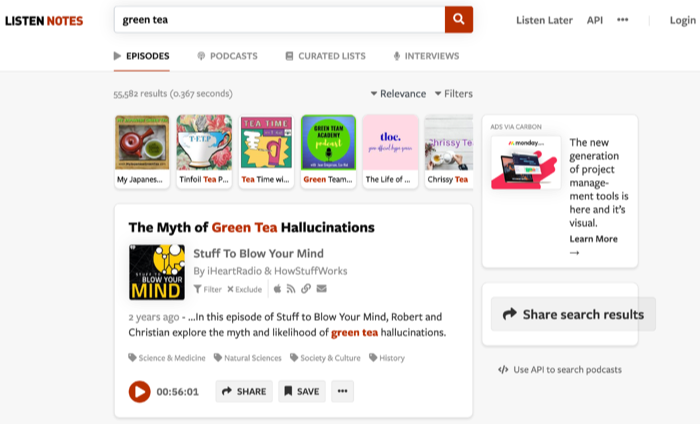
Step #2. Make Contact
Once you’ve created a list of targets, you’ll need to contact the podcasts and inquire about sponsorship details.
What are their pricing packages? What dates do they have available? Are there any gotchas?
Prices can range from $50 to $5,000 and beyond per episode, so work within your particular budget.
Step #3. Iron Out the Details
This includes your ad copy, delivery, and any other deliverables like your blog’s logo and elevator pitch.
In my experience, organic reads do much better than “scripted ads.”
The goal is to get the podcast host to sound like a fan and regular reader of your blog.
Step #4. Wait for Your Ad to Air
If anything is off, be sure to let the podcast know as soon as possible!
How to Promote Your Blog with Podcast Interviews
If you’re strapped for cash (or simply don’t want to do podcast advertising), another approach is to appear as a guest on podcasts.
This is usually free — unless you’re approaching extremely-popular podcasts, which tend to charge a one-time appearance fee.
The catch is you’ll need some kind of credibility to your name. In other words, you’ll need to convince the podcast host that you’re someone their audience would love to listen to.
The process for this is similar to the one detailed above:
Step #1. Create a Target List
Use Listen Notes or a similar tool to create a list of podcast targets.
Step #2. Check if They Accept Interviews
Often, podcasts will explicitly state on their websites whether or not they accept interview requests.
And if they don’t accept interview requests? Ask anyway.
Send in your pitch and convince them you have lots of value to add.
Step #3. Follow the Host’s Lead
Every podcast will have their own process. Some may want to do pre-interviews, some may want to work on a rough content online with you, and some may want to just “wing it.”
Whatever the process, remember to be courteous and respectful — you’re a guest, after all.
Just don’t forget to mention your blog!
Editor’s Note:
Appearing on podcasts is one of our favorite promotion strategies here at Smart Blogger — as evidenced by our appearances on EOFire, James Altucher, Duct Tape Marketing, the Write Podcast, and Loz James’ Content Champion.
Just make sure you’re prepared:
- Show up early to the interview so the host has time to do a sound check.
- Don’t use your phone or your laptop’s built-in microphone; instead, invest in an external microphone. Quality and price points vary, but you can get a simple microphone that plugs into your computer’s headphone jack for the price of a medium pizza.
- Use headphones to cut down on echoes.
- Turn off all notifications and, if you can, shut your door to minimize background noise.
#2. Republishing on Medium
Sure, you can publish tons of absolutely amazing posts on your own blog.
But if you never extend your reach, whether it’s by growing your list of email subscribers or boosting your number of social media followers, your audience will be limited.
So what do you do if you don’t have time to create promotional content and extend your reach?
Try this:
Republish your existing posts on blogging platforms like Medium.
Your content will be seen by a whole new audience — some of which will then visit your blog and discover all the great content you have to offer.
For example, look at this blog post I published on the Ahrefs blog last December:
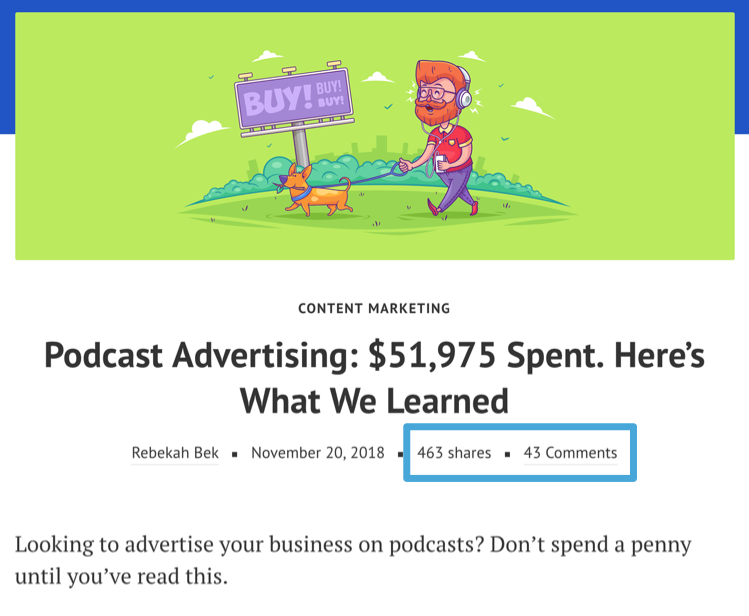
It got 463 shares and 43 comments — very decent engagement considering the fact that the topic likely didn’t appeal to our blog’s core audience (people interested in search engine optimization).
In a bid to push the post out to a wider audience, we republished it on Medium. It turned out to be a fantastic decision.
Here are the stats as of March this year:
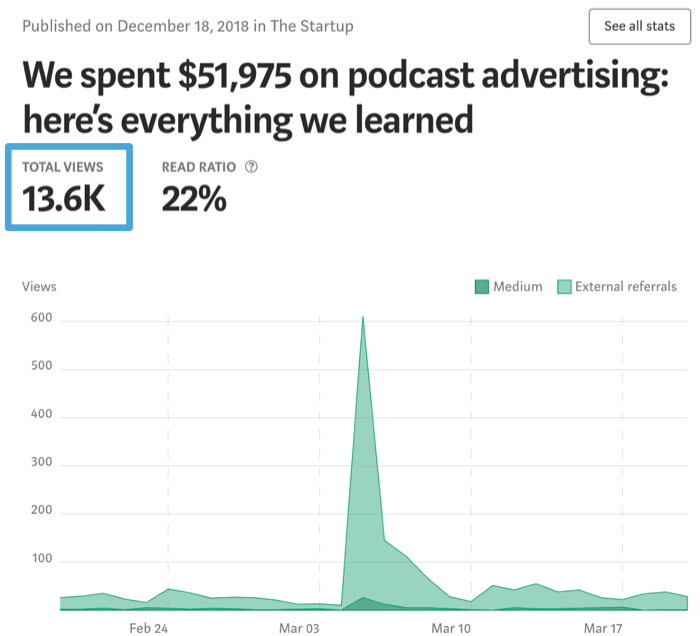
That’s 13.6k views in total, with 22% of readers actually finishing the whole post.
Plus, the Medium publication of this post averages a steady trickle of 10-30 readers every day.
Note: For the SEO-conscious among us, Medium uses canonical tags when you use their republishing tool. So no worries about duplicate content issues.
How to Republish on Medium
Medium has made the process of importing and republishing content super simple. Here’s how you do it:
Step #1. Choose a Post to Republish
Ideally, pick one of your top performers (since it’s already proved it’s popular).
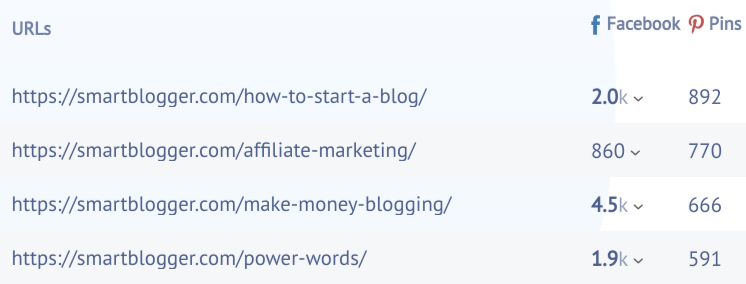
You can use a tool like Ahrefs’ Top Content report in Site Explorer to see which of your posts have the most shares on social media.
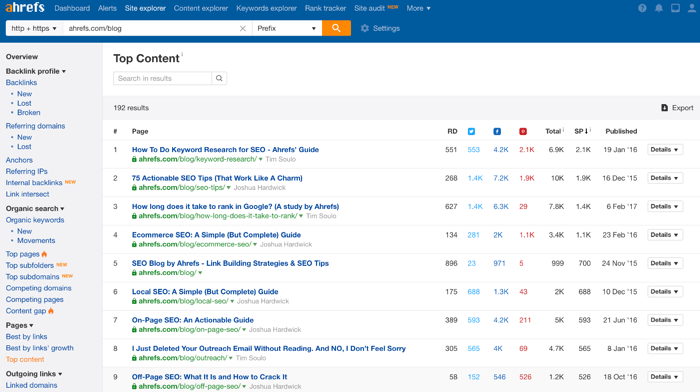
Since they’ve proven themselves on social media, these posts are the most likely to resonate with audiences beyond your blog’s existing one.
Editor’s Note:
Though they aren’t nearly as detailed, there are a few free tools to track social media shares if you aren’t an Ahrefs customer.
As an example, SharedCount.com lets you copy and paste URLs of individual posts; however, they only show counts for Facebook and Pinterest:
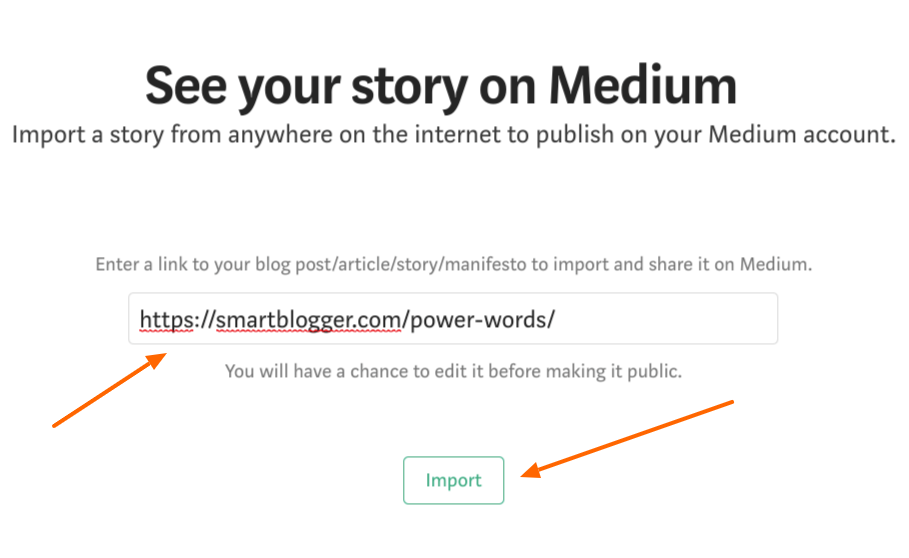
Step #2. Import Your Post Into Medium
Enter the URL of your post into the Medium import tool and hit “Import”.
Step #3. Publish Your Post on Medium
Follow Medium’s guidelines to format and polish your post, then click “Publish”.
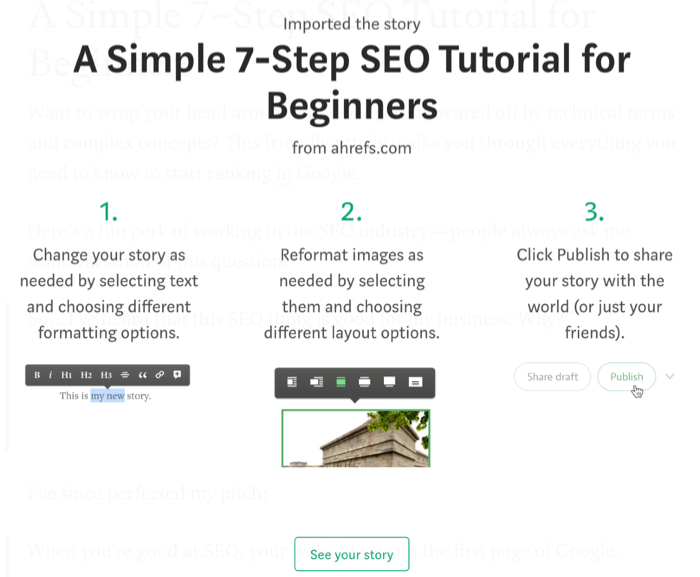
That’s all there is to it!
#3. Smart Social Sharing
I know, I know.
It’s 2019, and promoting your blog posts on social media is by no means a new strategy.
BUT — there’s more to social media promotion than pasting a link and clicking a “Tweet” button.
Here’s an example of the success we’ve seen from smart sharing on the Ahrefs Twitter account:

Pretty impressive, right?
Here’s another example:
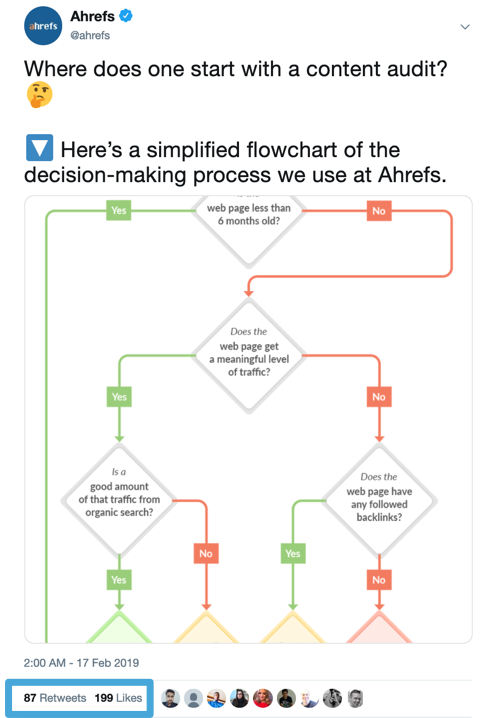
These tweets received amazing engagement, but we actually spent very little time creating them.
We achieved this ROI by working smarter, not harder.
How to Promote Your Blog Using Social Media (Smartly)
Here’s our process:
Step #1. Brainstorm Ideas and Organize Them
The great thing about social media content is it’s all fleeting. Even if an idea is a flop, it’s easy to turn the page and try the next idea.
But to make the most of these (admittedly fleeting) opportunities, you need two things:
- A large list of ideas;
- A method for grouping similar ideas into categories.
To brainstorm ideas, get a pen and paper (or launch Google Docs, Microsoft Word, etc.) and jot down things you would like to try.
Get as creative as you want.
Think memes would be popular with your audience? Write it down. Believe infographics or inspirational quotes could be successful? Write them down. Believe posts or tweets on Topic X or Topic Y could receive high engagement?
(You get the idea.)
By listing all of your ideas, you’ll then be able to group them into categories. This will help you track which categories are successful and which are not.
Step #2. Craft and Publish (and Monitor) Your Content
You can use social media management tools like Buffer and MeetEdgar to schedule your content and keep it running automatically.
Once your social media posts begin making their way into the wild, you’ll be able to track their progress.
Do some receive more comments, while others receive more shares and retweets? Are some more popular in the mornings, while others receive more engagement during the evenings?
All data, both good and bad, will help you in the next step.
Step #3. Review the Results
After an appropriate amount of time has gone by, hold a review.
Drop the categories that didn’t perform well. Keep the ones with potential and refine them.
You want to focus on the categories your audience likes and tweak them.
Do they like emojis, or do they gravitate towards a more “serious” tone? Do they like infographics, or long chunks of copy with statistics thrown in?
And so on.
From here, keep repeating steps 1-3 until you’ve locked down the type of content your audience loves.
And once you’ve figured out what they love, keep giving it to them.
Step #4. Advertising (Optional)
If you want to try advertising, the above process will save you some serious money.
Pick your top organic performers from Step #3 and put money into promoting them.
Since they’ve already proven themselves to be popular, this is a safe and effective way to buy ads to promote your blog (without wasting time and money on losers).
#4. Create Roundup Posts
The perks of this strategy pretty much sell themselves.
Here’s what happens when you publish a good roundup post:
- First off, it’s easy to write since most of the content is created for you;
- You make new and powerful connections within your industry;
- Thanks to those connections, you gain access to new audiences;
- Your post naturally gains backlinks and social shares.
So… what’s a roundup post, anyway?
Here’s an example:

Essentially, a roundup post features a compilation of answers to a single question, ideally by established experts in the field.
A great roundup post adds immense value to readers since they offer a range of expert opinions in one place.
Plus, they tend to bring in lots of traffic since the experts featured in them will often share the post with their own audiences.
What’s not to love?
How to Create Roundup Posts
Here are the basics of roundup posts so you can create your own:
Step #1. Craft Your Question
Don’t take this step lightly.
If you ask too much of the experts you’ll be polling, most won’t have time to participate (even if they want to). And if you ask a question they’ve heard (and answered) a million times, most won’t be interested.
Your question needs to be clear, succinct, and something that will appeal both to your readers and the experts you’ll be asking to participate.
Step #2. Create a List of Influencers
Once you’ve crafted your question, it’s time to create your influencer wish list. These are the influencers (“experts”) you’ll be asking to participate in your roundup post.
Since not everyone will respond to you, reach out to significantly more experts than you need.
For example, if you need 20 people for your roundup post, reach out to 40 experts (or more).
Remember:
A roundup post is only as good as the people you feature. While it takes exponentially more time and effort to get a response from a more recognized name in your industry, it’s likely worth it.
With that said, don’t expect the Michael Jordans of your industry to respond to your outreach — try to find people with a reasonable level of influence who aren’t complete titans.
Step #3. Reach Out to the Experts
You can use specialized tools like BuzzStream or Mailshake to streamline the entire outreach process by making it easier to hunt down email addresses, batch send messages, and conduct follow-ups.
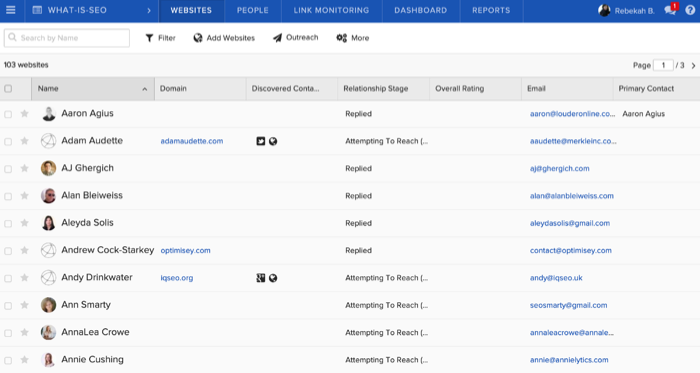
Quick tips for the message you send:
- Keep it short;
- Keep it genuine.
Step #4. Follow Up (But Only Once)
There’s a chance your first email will slip past the expert you’re trying to reach. After all, they’re very busy and likely receive dozens (or hundreds) of emails every single day.
This is why sending a follow-up email is helpful:
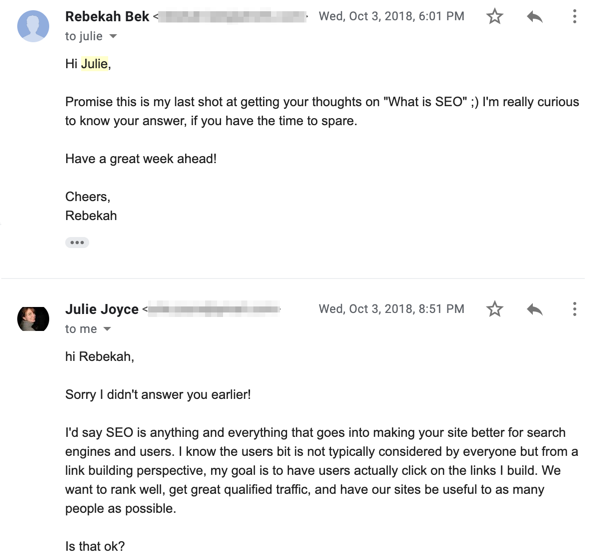
However, please don’t follow-up more than once — any more than that and you’re just being a nuisance.
Step #5. Compile Your Responses
At this point, you’ll have a bunch of answers ready to sift through. Now all you need to do is turn them into a cohesive post.
Try to find trends in the responses and sort them into sections.
Next, add your own introduction to each section, as well as your opinion on why certain trends occurred.
This is how you put your stamp on the roundup post and make it your own.
Step #6. Publish Your Post (And Tell the Experts)
Once your post is published, it’s time to let everyone know about it.
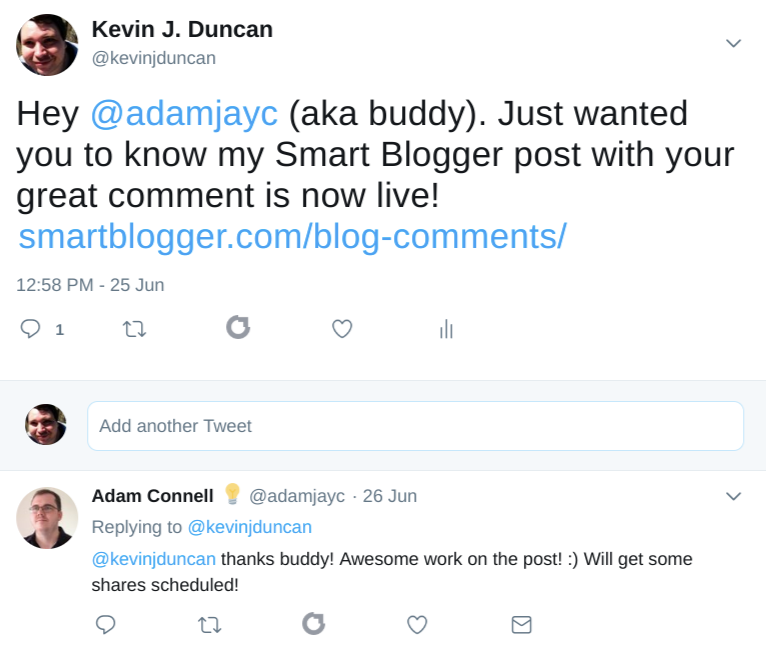
Email everyone who responded to your outreach emails (whether they ultimately contributed to your post or not) and thank them for their time. Include a link to your post, and be sure to send them well-wishes.
You can also ask them (politely) to share your post with their audience, but this is often implied.
Editor’s Note:
Want to let influencers know your post has been published and promote the post at the same time? In addition to emailing them, tag the influencers on Twitter too.
#5. Advocate In-Person
While all blogs are digital in nature, your promotional efforts aren’t limited to the digital world alone.
It might be a step (or ten!) outside your comfort zone, but try this:
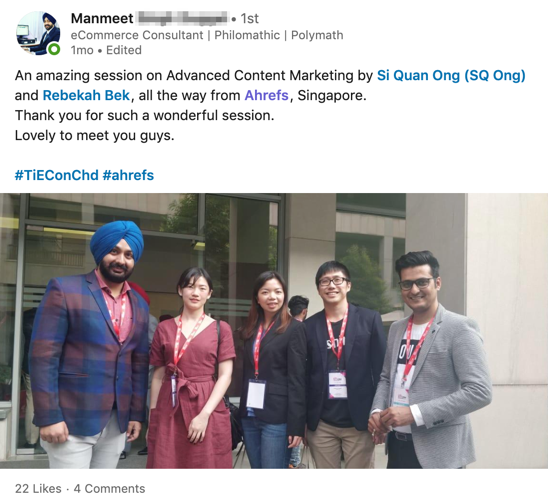
Approach a local event in your niche and pitch yourself as a speaker.
It doesn’t matter where you are in the world or how big the event is — it could even be a small meet-up session.
The idea is to reach out to new people and give the work you do a huge visibility boost.
How to Promote Your Blog by Speaking at Events
If you’re interested in this advanced promotional tactic, here’s how to get started:
Step #1. Shortlist a Few Events or Meet-Ups You’d Like to Attend
If you’re not sure where to start, look around on Reddit, Facebook groups, or Slack groups and join some communities in your industry.
Chances are good people are organizing and promoting events in these communities.
Make a list of potential targets, underline your favorites, and move on to the next step.
Step #2. Pitch Yourself to Event Organizers
When pitching yourself, propose some topics that you’d be comfortable speaking about and explain how your content will add value to their audience.
Hopefully it goes without saying, but you should know these topics very well.
Note: If you have no experience with public speaking, it’s a good idea to start small. Save the conference keynote speeches for later.
Step #3. Craft Your Presentation
Try to deliver as much value as you can and position your blog as a great resource. This is also a good time to promote your social media accounts, which are ideally already geared towards driving traffic to your blog.
Just be sure not to make it all about you. Your job is to teach, to impart your know-how to others.
And when you’re able to do this well, promoting your blog will happen organically.
Step #4. Speak
Show up to the event, deliver your speech, meet lots of new people, and enjoy converting some new readers!
Editor’s Note:
To improve your chances of landing speaking engagements, make sure you:
- Have a website (aka your business card);
- Create a 2-3 minute demo video (aka your movie trailer);
- Acquire a few testimonials (from people willing to vouch for you).
There’s a lot more to it than we can unpack here, so be sure to check out Grant Baldwin’s post How to Get Speaking Engagements. In fact, browse his entire website, The Speaker Lab. It’s chock-full of helpful information.
#6. Integrate Your Blog with Your Product
Most businesses have blogs that are completely disconnected from their main product.
If you blog for a brand or business, why not align your messaging and integrate your blog posts directly into your UI (for software products) or in your product descriptions and previews (for e-commerce)?
This lets you direct traffic over to your blog and gives your customers a more seamless experience.
How to Fuse Your Blog and Product
For software products, one way to notify people of your newest blog posts is to include a (preferably unobtrusive) in-app notification.
Here’s what it looks like when using Ahrefs:
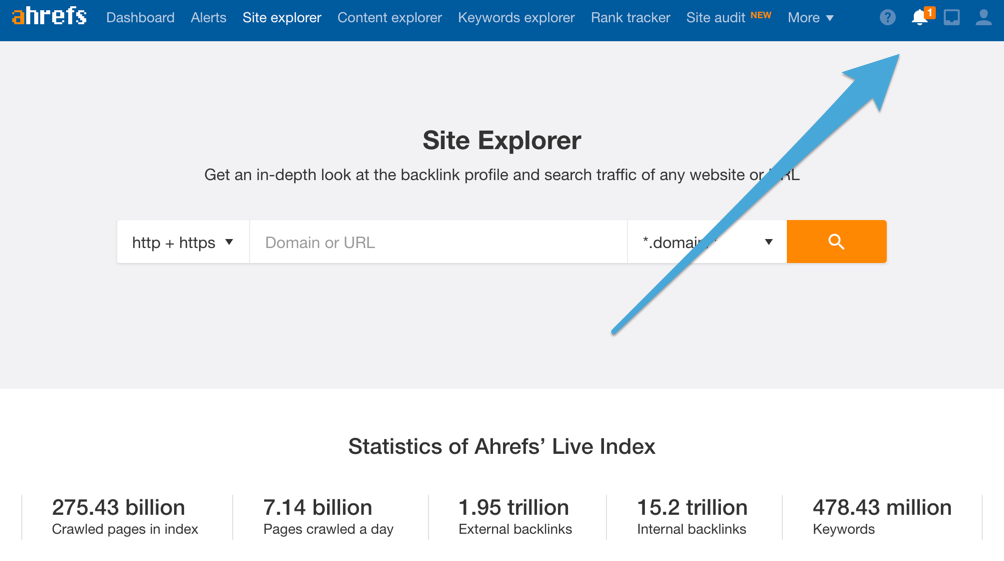
Click the bell icon and we display a simple drop-down menu listing all our newest content.
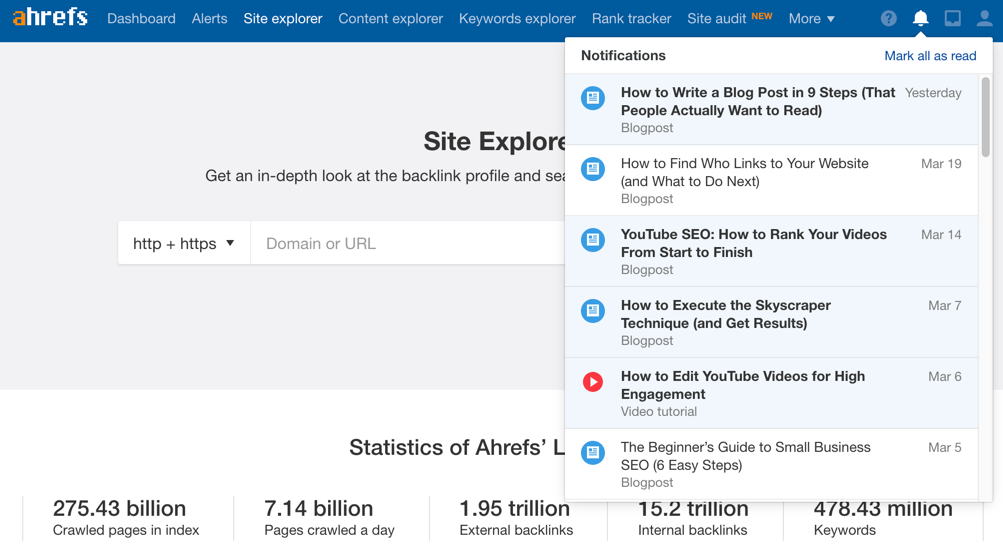
So simple, but so effective.
If you have an e-commerce website and your blog posts are educational in nature, you can promote them directly on your homepage.
Beardbrand does this beautifully:
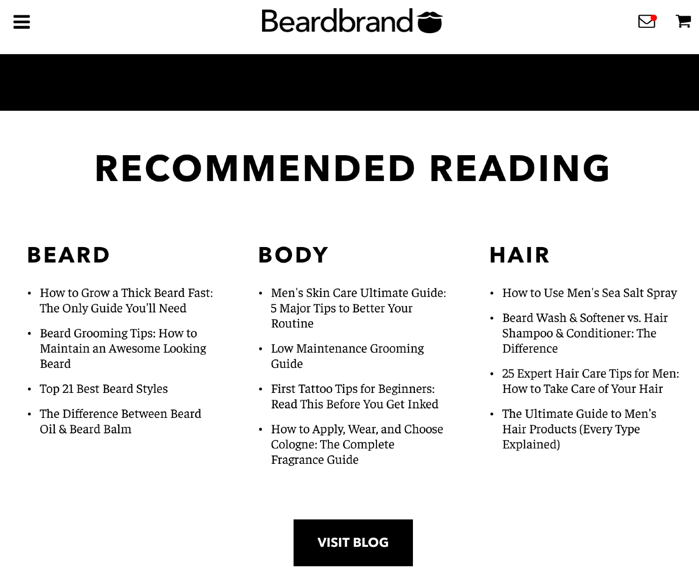
Another way to do this is by scattering in individual links and excerpts of your blog posts wherever they’re relevant. This is how Mr Porter does it:

Time to get creative!
Editor’s Note:
Here’s one more tip that’s missed by a surprising number of business websites…
Include a prominent link to your blog in your website’s navigation menu.
Ahrefs, MeetEdgar, Elegant Themes (affiliate link), and many other smart businesses feature their blogs in their navigation, which helps drive traffic to them.
Here’s how Quuu (affiliate link) does it:

In other words:
If people have to hunt to find your blog ON YOUR OWN WEBSITE, you're doing it wrong.Click To Tweet#7. Collaborate with Other Blogs
Creating content in collaboration with another blog means you’re able to tap into each other’s audiences and can promote yourself to a whole new set of blog readers.
You can even split the work!
Here’s a post that Ahrefs did with Buffer, a social media management tool:
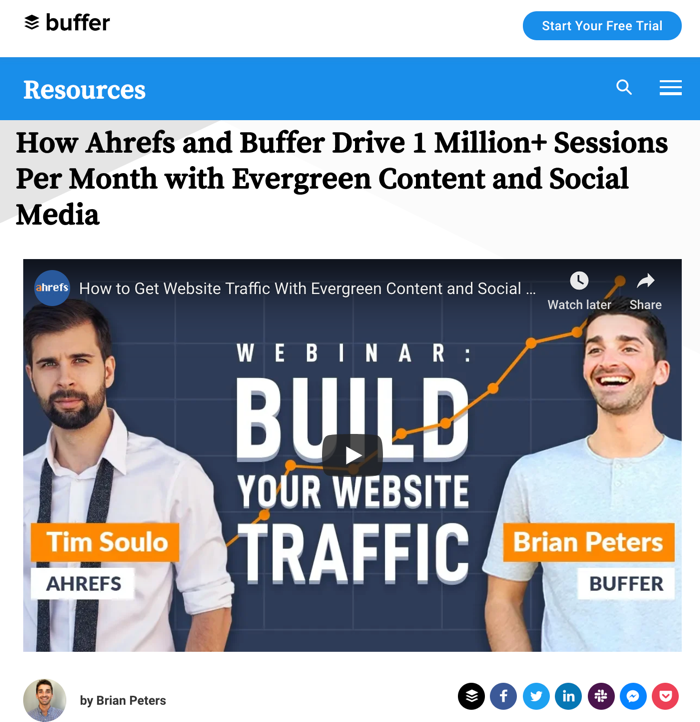
How to Join Forces With Another Blog
Fair warning:
Collaborating with blogs significantly larger than yours probably isn’t in the cards. However, collaborating with a site similar in size is definitely doable.
Here’s how to get started:
Step #1. Find Opportunities in Your Niche
Look for opportunities to work with blogs within the same niche as yours.
Start by approaching bloggers you have an existing relationship with and ask if they’d like to collaborate. You should leave cold pitching as a last resort.
If you have no idea which blogs to approach, Ahrefs offers a nifty trick:
In Content Explorer, enter a relevant keyword phrase in your niche.
Set the “published” filter to “Last 12 months” and the “Language” filter to “English”. Next, highlight the “one link per domain” option.
Finally, you’ll want to set one more filter: DR (“domain rating”).
The higher this number, the more authoritative the website; however, the more authoritative the website the harder it will be for you to get the blogger’s attention.
In the screenshot below, we set the DR to 40:

This will pull a list of active blogs in your niche.
From here, just sift through the possibilities and pick the ones you’d like to approach.
Step #2. Make Your Pitch
The process is pretty similar to advocating in-person: you need to make your best pitch.
Focus on explaining why you want to work with that particular blogger, as well as how collaboration will benefit them.
Feel free to suggest a couple of topics you feel would work well.
Step #3. Create
Creation time!
Finalize your content with the blogger you’re working with and remember to stay prompt and gracious throughout.
This is not the time to get pushy or rude and make an enemy out of a would-be ally.
Step #4. Publish and Promote
Promote the post to your newsletter and social media accounts. Make sure to tag and give credit to the other blogger too.
#8. Repurpose Content Into Other Formats to Reach New Audiences
You’ve spent all this time and effort to create amazing content in the form of blog posts.
Why not get more out of the same piece of content?
Since your customers hang out in multiple places online and have their own preferences when it comes to content formats, you should try to reach audiences beyond blog readers.
And you do that by repurposing your content.

How to Repurpose Your Content
Some examples:
- Turn your blog posts into SlideShare presentations;
- Take a small section of your blog post and reimagine it as an infographic;
- Convert your blog post into a YouTube video.
Or, do it in reverse.
We published a YouTube tutorial on WordPress SEO. It has over 20,000 views and 70 comments — not too shabby.
We decided to turn it into a blog post. Here’s how it performed:
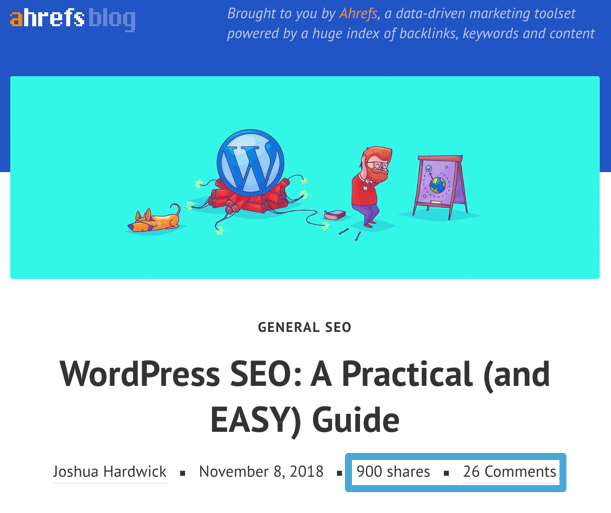
By re-creating our video in written form, we were able to reach an entirely new audience on an entirely different platform.
And the best part?
We didn’t have to come up with fresh content for the post. We took what we already had and created something new with it.
#9. Monitor Online Conversations for Opportunities to Promote Yourself
People talk about all sorts of things on the Internet, including your niche.
If you monitor these conversations, you’ll get lots of chances to slide into the discussion, add value, and (subtly) promote your blog.
Here’s a pretty meta example of this tactic in action.
I once mentioned Talkwalker alerts in a blog post I wrote, and an employee commented on the post to provide the link:
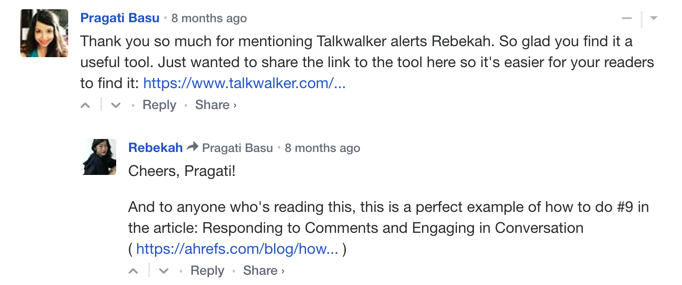
How to Monitor Conversations for Promotion Opportunities
Tracking online conversations is surprisingly easy. Here’s how you do it:
Step #1. Set up Your Alert
You can use a free tool like Google Alerts, or services like Talkwalker Alerts and Ahrefs Alerts.
For Ahrefs, go to Alerts, Mentions, +New Alert, and enter your keyword you’d like to track.
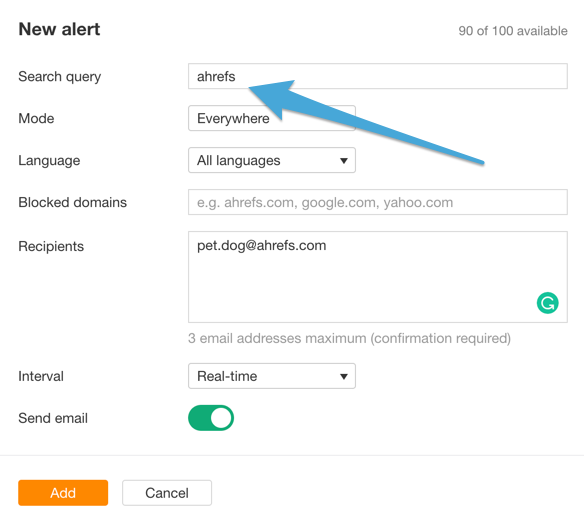
What these tools do is send you an email every time a keyword is mentioned on the web.
From there, you can simply follow the link in the email to find out where you’ve been mentioned.
Step #2. Carefully Monitor Your Mentions
Whether your mention comes in a blog article or a forum discussion, look for suitable areas where you can add value.
For example, if you’re a food blogger and you receive an alert for a discussion of a restaurant, it’s your time to shine by talking about your own experience.
However, a word of warning:
It’s extremely important not to shoehorn yourself into conversations.
If you’re clearly only there to advertise your own blog, people will catch on pretty quickly.
So, be sure to link to your own blog strategically, and only after you’d added value to the discussion.
Editor’s Note:
You can also track mentions using Twitter’s advanced search.
For example, let’s say I wanted to find every English-speaking tweet in 2018 that mentioned Jon Morrow by name:
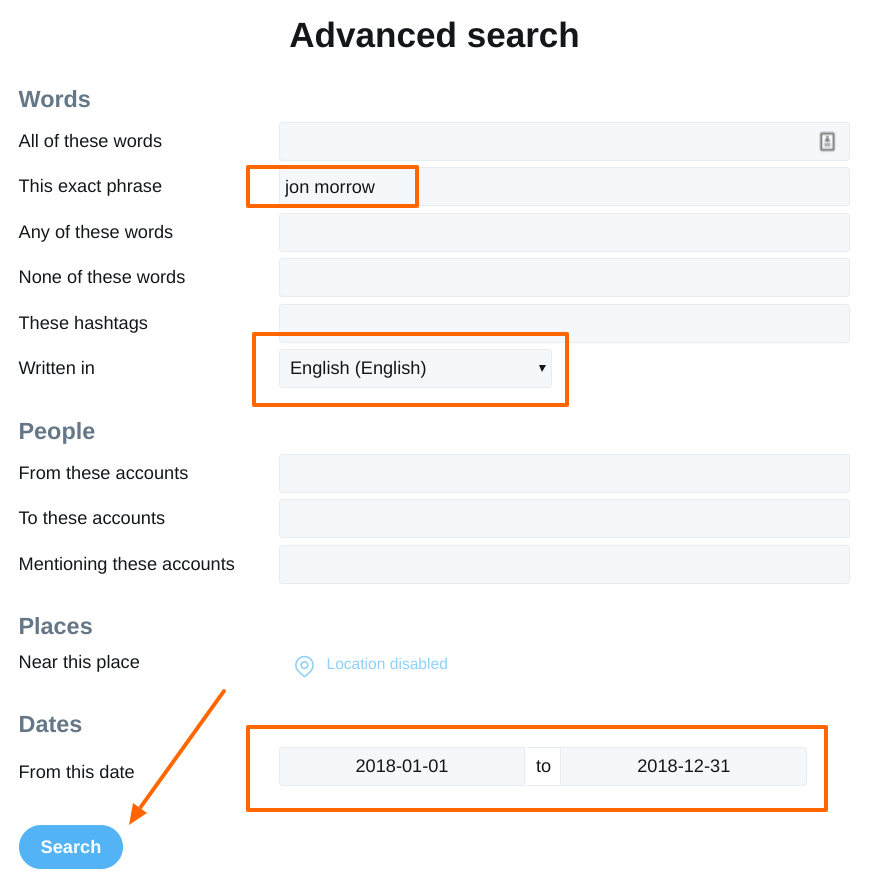
Twitter’s advanced search results would return a veritable smorgasbord of tweets:
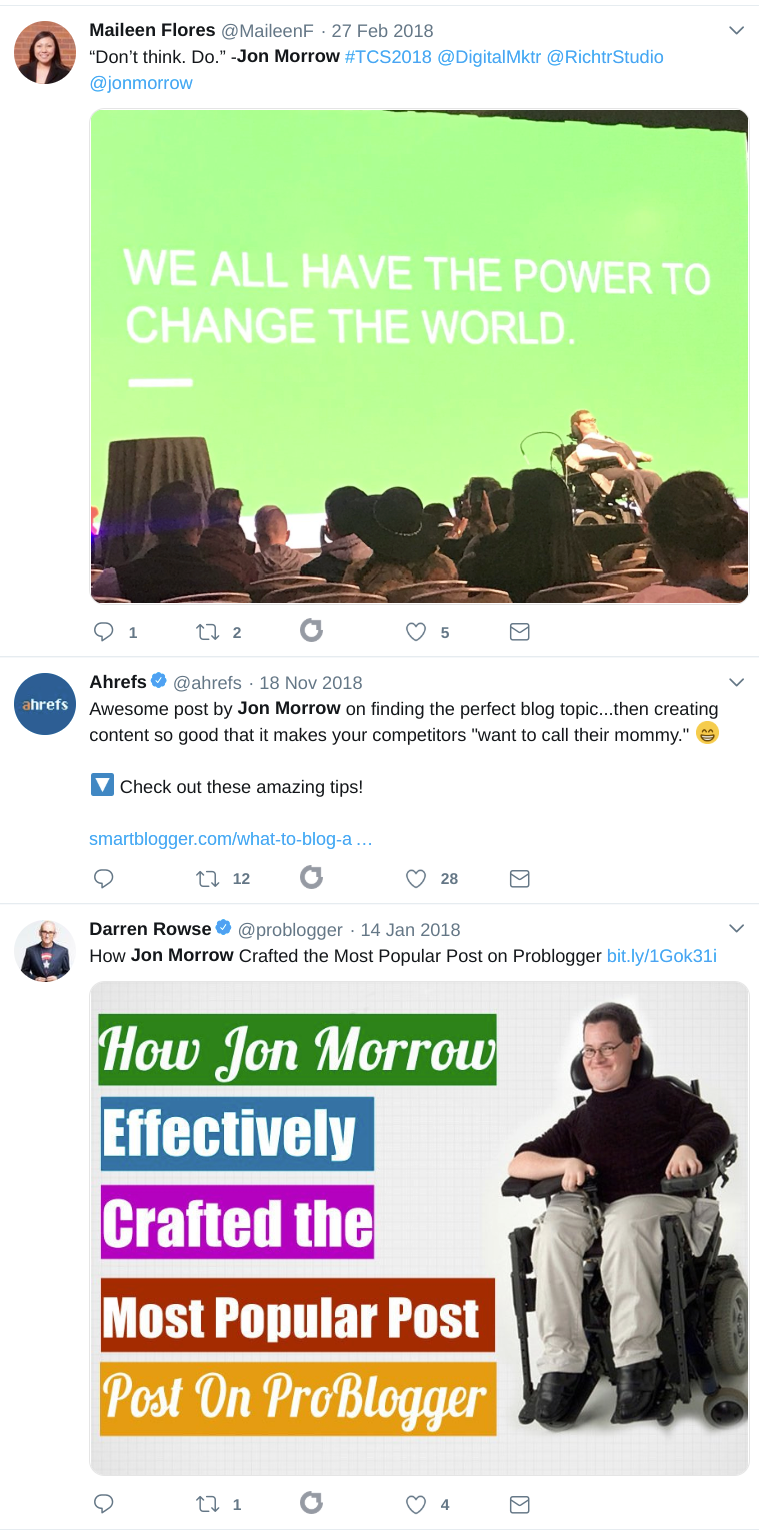
Cool, right?
Use this feature to find keywords and mentions that matter to you, roll up your sleeves, and then get to work. The applications are nearly limitless.
Over to You
If you sometimes find yourself lying in bed at night wondering, “how do I increase my blog traffic?”, I feel your pain.
I did my best to stay away from the more common methods of blog promotion, so hopefully you found something new to try.
Of course, not all of the tactics we discussed will be suitable for, or will work for, your blog and your particular niche.
You’ll need to experiment and find what works for you.
When it comes down to it, marketing is always about experimenting — experimenting, failing, and going at it again and again until you succeed.
Now, go forth and get that traffic!
The post How to Promote Your Blog in 2019: 9 Creative Strategies appeared first on Smart Blogger.
from How to Promote Your Blog in 2019: 9 Creative Strategies
Should You Use ‘He’, ‘She’ or ‘They’ in Your Blog Posts?
The post Should You Use ‘He’, ‘She’ or ‘They’ in Your Blog Posts? appeared first on ProBlogger.
 This is a post by ProBlogger writing expert Ali Luke
You probably already know you should use “I” and “you” in your blog posts. But how do you use “he”, “she” and “they” in your blogging?
It’s an important issue, and one bloggers don’t always think about.
Let’s say you’re working on a blog post and you’ve got a sentences like this:
If you want to hire a blogger to write for you, it’s important that [PRONOUN] can provide you with relevant samples of [POSSESSIVE PRONOUN] writing.
What should go in the ‘pronoun’ spaces? There are several potential options, some of which are more appropriate than others.
Option #1: If you want to hire a blogger to write for you, it’s important that he can provide you with relevant samples of his writing.
Option #2: If you want to hire a blogger to write for you, it’s important that she can provide you with relevant samples of her writing.
Option #3: If you want to hire a blogger to write for you, it’s important that he/she can provide you with relevant samples of his/her writing.
Option #4: If you want to hire a blogger to write for you, it’s important that they can provide you with relevant samples of their writing.
Option #5: If you want to hire a blogger to write for you, it’s important that it can provide you with relevant samples of its writing.
We can dismiss option #5 immediately. In most contexts, “it” sounds bizarre and dehumanising when referring to a person. (There are a few exceptions, such as “It’s a girl!” when a baby is born.)
So which of the other four options should you pick. And why does it matter?
Option #1: Use “He” Because It’s How It Was Traditionally Done
If you want to hire a blogger to write for you, it’s important that he can provide you with relevant samples of his writing.
A few generations ago, a sentence like this wouldn’t have raised an eyebrow. (Well, other than because “blogging” wasn’t a thing back then.)
Traditionally, “he” could be used in this type of sentence as a neutral pronoun to encompass both male and female. Old style guides might still suggest it be used that way.
But today it’s rare to come across any writer who believes “he” can be used neutrally. Regardless of the intent, “he” inevitably implies the person being referred to is male, not female.
In our example sentence, using “he” might be seen as implying that freelance bloggers are mostly male (or even that they should be male), which is far from ideal.
One case where it might make sense to use “he” for hypothetical people is when you’re writing for a blog aimed solely at males (e.g. a blog about prostate cancer). But it can still be an issue, as we’ll come to when we discuss the use of “they”.
Option #2: Use “She” to Make a Point
If you want to hire a blogger to write for you, it’s important that she can provide you with relevant samples of her writing.
An alternative approach is to use “she”. It’s likely to stand out because it’s not as common as using “he”, which may be what you want. For instance, you might want to challenge the reader’s unconscious assumptions by using “she” to talk about hypothetical CEOs or managers.
The danger with this approach is that, just like using “he”, it can come across as exclusive and ruling men out of the conversation. It could also imply that you feel some roles are or should be female only (e.g. using “she” when talking about an assistant or secretary).
Again, “she” might make sense is if you have a blog aimed solely at females (e.g. a blog about breast cancer). But it can also be an issue, as we’ll come to when we discuss the use of “they”.
Option #3: Use “He/She” to Keep Things Equal
If you want to hire a blogger to write for you, it’s important that he/she can provide you with relevant samples of his/her writing.
The advantage of this approach is people won’t object to it on grammatical grounds. But if you do it for more than a sentence or two it becomes very clunky to read, which is a real disadvantage.
You could use “s/he” instead of “he/she”, but that also starts to look clumsy after a while. And there’s no real variation for “his/her”.
Still, if you’re writing something very formal or official then using “he/she” might be your best option.
Another alternative is to alternate between “he” and “she” in successive blog posts, or perhaps in successive examples within a single blog post. So you might write something like this:
If you want to hire a blogger to write for you, it’s important that he can provide you with relevant samples of his writing.
[…]
Make sure you offer your freelance blogger feedback on how she is doing. It’s unfair to blame her for not meeting expectations you haven’t clearly set out.
If you’re determined to avoid using “they” (which we’ll come to in a moment), then alternating between “he” and “she” is probably the best method. But you need to make sure you are alternating (rather than simply throwing in a “she” occasionally), and that you’re not using “he” for higher status roles than “she”.
Option #4: Use “They”, Either as a Singular Pronoun or By Rewriting the Sentence
If you want to hire a blogger to write for you, it’s important that they can provide you with relevant samples of their writing.
This is my favourite option. These days I simply use it as a singular pronoun. I know some people dislike that, but it’s become very common across all sorts of media. (It’s also found in writing going back centuries, as the Oxford Dictionaries site explains here.)
There are several crucial advantages to using “they” in this way:
- It’s truly neutral
- It doesn’t look clunky like “he/she” or “s/he”
- It’s inclusive of non-binary readers
That third point is important, and may need some unpacking.
Some of your readers may not identify as being either male or female. This can be the case even if your blog is aimed at a particular biological sex. (If you’re writing about breast cancer or prostate cancer, some of your readers may well be non-binary. You might also have transgender readers.)
The preferred pronoun for most of these readers is likely to be “they” (though there are other options such as “ze”), so using it as your all-purpose neutral pronoun makes great sense. That way you’re including all your readers: male, female and non-binary.
But if you’re strongly opposed to using “they” as a singular pronoun, there’s a simple solution: rewrite your sentence to make the subject plural.
If you want to hire bloggers to write for you, it’s important that they can provide you with relevant samples of their writing.
While it won’t work for every sentence of this type, in most cases it will solve the he/she/they issue. No-one will fault you on your grammar, and it’s inclusive of readers of any gender.
Why This Matters (Even Though It’s Your Blog)
A few weeks ago the he/she/they issue generated a huge discussion in the ProBlogger Community group on Facebook.
One of the views there was along the lines of:
It’s my blog. I’ll do what I like, and if readers don’t like it then I don’t want them as readers anyway.
Another view was along these lines:
People get offended too easily these days.
While I can understand those perspectives, I disagree with them.
Of course we should be free to run our blogs however we like, and that includes the language we use. For instance, bloggers who swear frequently might feel it’s a crucial part of their brand. And they’re happy to pay the price of losing some readers who don’t like that kind of language.
But I don’t think we should see he/she/they as a minor, insignificant issue that people are just waiting to be ‘offended’ over.
Instead, it’s an opportunity to bring about a more equal world where people of all genders feel equally valued and welcomed, which is hopefully something we all want. As bloggers and writers, we have an important role to play here.
Of course, in the end it’s your blog and your choice about the pronouns you use. All I ask is that you give it a bit of thought, and consider that your assumptions (e.g. “Everyone knows ‘he’ can be used as a neutral pronoun”, “Everyone is either a ‘he’ or a ‘she’”) might not be correct.
It’s also worth keeping in mind that language changes and evolves over time. And that’s a good thing. It means the words we use reflect the changing society in which we live. Just because a particular grammatical rule or guideline was in use fifty years ago doesn’t mean it should still be used today.
How do you handle the “he/she/they” issue on your blog? Is it something you’ve already considered? Is there something you might change going forward? Let us know your thoughts in the comments.
Image credit: Tim Mossholder
The post Should You Use ‘He’, ‘She’ or ‘They’ in Your Blog Posts? appeared first on ProBlogger.


from Should You Use ‘He’, ‘She’ or ‘They’ in Your Blog Posts?
Hello Everyone!
Problem: I emailed a person. Now, Gmail shows some irrelevant auto-reply suggestions to the receiver. My question: Is it possible to manually set ...
from Hello Everyone!
from Hello Everyone!
Wednesday, April 3, 2019
Open source affiliate program script
Does anyone here know any open source script so that I can host an affiliate program. I want affiliates to send traffic and when a visitor b.
from Open source affiliate program script
from Open source affiliate program script
Where to find micro influencers?
Does anyone here know any open source script so that I can host an affiliate program. I want affiliates to send traffic and when a visitor becomes a ...
from Where to find micro influencers?
from Where to find micro influencers?
Subscribe to:
Posts (Atom)