Showing posts with label DigitalMarketer. Show all posts

Thursday, November 12, 2020

How to Make Sure Your Social Media Posts Really Stand Out in 2021

With so many brands investing more and more in their social media presence, it is becoming harder and harder to stand out.

You need to be always experimenting with new tricks and formats, and you need to always surprise your current followers to acquire new ones.

With that in mind (and as a preparation for the fast-approaching new year), I’ve compiled a list of some of the most creative tools and tricks you can use to make your social media content stand out!

Of course, different social media platforms may require different tricks, but this collection of ideas offers almost universal tips and examples:

1. Up Your animated GIF Game

Images have scientifically been proven to improve social media engagement and animated images perform even better, so it is only natural to start by upping your visual marketing game.

From creative cinemographs to humorous movie memes, animated GIFs made a confident come-back to our lives a few years ago, and they remain powerful social media content these days.

You can certainly find great animated GIFs online (or even download from Twitter), but your best bet is—as always—to create your own original content. The good news, you don’t need to hire designers or buy expensive software for that.

Pixaloop, a creative app by Lightricks, is one of my latest (and favorite) discoveries. Pixaloop allows you to “bring your photos to life.” In essence, the app allows you to animate any part of your photo:

  • Use arrows to set the motion direction
  • Place anchors to hold parts of image in place
  • Freeze sections of photos to keep them still.

On top of that, you get a variety of video effects, overlay objects (stars, butterflies, candle flickers, coffee steam, etc.), camera effects, and movements. It is a powerful toolset for creating awesome updates that can fit just about any social media feed, regardless of the platform.

The app has a free option which I upgraded to an unlimited access for (I think) about $4 per month.

Get Free Access to DigitalMarketer's Training Library

2. Take Advantage of ASCII Art

Text art (also referred to as ASCII art) is another older trend that made a comeback thanks to Twitter.

There are many people out there that don’t appreciate ASCII art; we call those people “idiots”.

Somewhere between the widely popular shrug emoticon and the sign bunny memes, turning your keyboard symbols into funny cartoons is a thing again!

Some brands are actually becoming famous due to the creative (and well-branded) ASCII art. @MoonPie is the perfect example of putting their products inside a hilarious and sharable context by using basic ASCII art:

If you are willing to explore this trick, here are a few resources and tools helping create social-media-friendly ASCII art:

3. Create Long-Form Content

Long-form content is an overall trend that impacts many marketing tactics. More and more brands are creating huge lists and tutorials that take hours to read. They have been found to rank better (longer content receives 77.2% more backlinks than short articles) and they appear to do well on social media.

But long-form content is not only good for your on-site content—it’s also great for social media updates. More and more thought leaders are putting long Twitter threads together that read like articles. For example, when talking about Quora on Twitter, Anita Campbell, founder of Small Biz Trends, includes personal stats, results, and tips to achieve more on Quora.

Obviously, Twitter is not the only social media platform to try long-form content. Other networks seem to be adopting longer content formats as well. Fohr has published a research study claiming that the average caption length on Instagram has more than doubled since 2016.

[There’s a good reason to believe, the caption length will grow even more in 2021]

Sharing stories on Instagram is quickly becoming a thing! Followers like to watch pictures, but it’s the text caption that makes them comment, answer questions and contribute their opinions.

When creating long-form content, don’t forget that it is still your official account and your brand. Make sure your voice is consistent and professional:

  • Before you ever schedule long-form posts for social media channels, proofread everything. It is a good idea to use a grammar checker tool.
  • To generate more ideas, use Text Optimizer. It will suggest more angles and help you create better optimized context for your long-form content:

Bonus: Keep an Eye on Your Results

No serious marketing strategy can exist without careful and consistent measuring of results. Social media is no exception. There’s no shortage of social media analytics tools that help you monitor your content performance and identify your best performing updates.

Agorapulse is one example. It gives you full control over your social media schedule and helps you track your cross-channel content performance.

It is always a good idea to adjust your analytics dashboard to instantly see how your social media traffic is interacting with your site. There are a few powerful solutions for that that also integrate with your site, but the easiest (yet the most in-depth) one is probably Finteza: a service that lets you slice and dice your data by traffic sources, demographics and on-site engagement:

Conclusion

Creating social media updates that stand out is art. There’s no single way to do that. It takes weeks and months of experimentation and measuring results. It involves lots of brainstorming and creativity. And this makes the process so exciting!

I hope the above ideas will help you come up with some original social media content that will bring new followers and brand advocates. Good luck!

Get Free Access to DigitalMarketer's Training Library

The post How to Make Sure Your Social Media Posts Really Stand Out in 2021 appeared first on DigitalMarketer.


from How to Make Sure Your Social Media Posts Really Stand Out in 2021

Wednesday, November 11, 2020

Rethinking the 3 Ps of Business

If you own a business, or have ever taken a basic business class, then you’re probably familiar with the 3 Ps.

People. Product. Process.

According to the guiding principle of the 3 Ps, managing these three most important factors of a business will help you find unchallenged success. They are the building blocks that help construct a successful business. See, without the right people, a good product, and a proven selling process your business will fail.

But there are thousands of businesses that have all of those things and still find themselves struggling to get by. So what’s missing? Why don’t the 3 Ps alone take your business as far as it needs to go?

Turns out, there is a fourth P that nobody mentioned. Until now.

As important as your people, product, and process are, your positioning is just as important. And especially for all you marketers out there, you know this better than anyone.

When it comes to your product and your process, positioning is an integral part of the equation. Think of positioning the same way as marketing—it’s figuring out how to frame and advertise your product in a way that makes it more appealing to your audience.

Positioning is something that Donald Miller, CEO of StoryBrand, talked about in our recent workshop. It’s an often-overlooked factor of your business that, according to Donald, will make or break you.

Deprioritizing positioning is a mistake that a lot of new business owners make. By not focusing on how you position, promote, and advertise your product/service, you’re putting a cap on your potential for growth. So, we are taking a few tips from Donald Miller and breaking down this forgotten 4th P of business so you no longer wonder why you’re struggling even though you’re doing everything else right.

This image has an empty alt attribute; its file name is DonaldMiller_blog-1024x538.jpg

How Positioning Works

First, you need to ask yourself a few questions:

  1. How is your product actually positioned in the marketplace?
  2. How does that positioning help differentiate you and set you a part in your industry?
  3. Can people figure out easily what you sell and what problem you solve?

All of these answers will help you create your core positioning message, which is something you want your customers to be extremely familiar with.

You want your customer to be able to recite your core messaging back to you. You want them to be able to give you a summary of the purpose of your business. You want them to memorize the problem that you solve.

If you create this kind of brand recognition, it demonstrates that you’ve done an effective job at bringing awareness to your brand, thereby increasing your business’s chance to be successful.

Why Positioning is Important

Remember how we said that positioning is just as important as the other 3 Ps? Well we lied.

Positioning is probably the most important aspect of building your business, even more important than your product itself. That may sound like a stretch, but it’s true.

See, selling well and becoming an authority in your market aren’t just about having the best product or offering the best price. Those things certainly factor into the equation, and good product and low pricing will most certainly help you sell more. But your messaging and positioning are ultimately the things that’s going to help your ability to effectively position and market your product is more important than anything else.

If you’re wondering why that’s the case, it’s because of psychology.

People don’t inherently buy the best product or the flashiest product… they buy the product that they can understand the fastest. That’s because the less mental energy needed to understand the product and what it does, the more likely it is that they will want to buy it.

That’s because our brains are designed to ignore or forget things that don’t matter (we talk more about that in this blog post about how to market for your brain’s survival instinct). We inherently put on blinders to things that don’t interest us, and at a very basic level, aren’t going to help us survive. Even in the context of buying a product, our ability to survive is subconsciously on our mind. That’s why people will almost always buy a product with proper positioning; their brains actually want to pay attention.

If you can properly position what you want to sell, you are going to outsell your competitor every time. It doesn’t matter if competitor’s product is better than yours—if your messaging is better, you will always be the winner.

The Rules of Positioning

Properly positioning your product isn’t rocket science—you already understand that good messaging and marketing are the factors that go into proper product positioning.

But execution is really key.

And although prior marketing experience—which most of our readers have—is certainly helpful, it can also hurt you to an extent if you’re not careful. That’s because of the (very basic) first rule of positioning…

1. Be Clear

If you are in marketing, you’ve probably spent hours thinking of a neat, clever, and cool way to attract customers to your products and get your company’s message across. Sometimes, that method can be really effective in a niche, insider-oriented audience.

But when it comes to foundational product positioning, it’s not the best practice.

Again, people are drawn to products that they can understand the easiest. Not only that, but you only have about 8 to 10 seconds to get a person’s attention and have them decide if they’re going to listen to you or not.

For both of those reasons, clarity is key.

Marketers want to feel like they are smart, clever wordsmiths. And as much fun as it may be to come up with a fun, product-based pun that you and your marketing team think is hilarious, there’s a pretty decent chance your customer will be checking out before they ever hit the punchline.

And, at worst, they’re going to be totally confused. That is the absolute last thing you want.

That doesn’t mean your copy and salesmanship needs to be totally boring and dry. That’s not a good approach either. But when placed up against cute and clever, am emphasis on clarity is always the approach that will win.

The quicker you can get your audience to understand what you do, the more likely it you will convert them into paying customers. Don’t make them guess… just tell them. If you do, then you, your customer, and your business will be much happier in the long run.

2. Utilize the power of narrative

Story telling is an art form that humans have been perfecting since the beginning of time. It is truthfully one of the most effective and powerful tools humans have, which is why marketers and businessowners need to learn how to properly utilize it.

People connect with stories: we have an emotional response to them, react to them, and, most importantly, we remember them.

And, if you remember from earlier, making your product memorable to your customer is the best thing you can do to get them buy.

Using a story for positioning is really effective because it does 2 things:

  1. It more engaging than a sales pitch
  2. It gets your customer involved

Your information will be way more memorable because your customer will pay a lot more attention. Traditional style, direct response sales pitches are essentially 5-minute college seminars that people often tune out. And if people pay thousands of dollars to go to college and still don’t listen to seminars, what makes you think they’ll listen to your mini one?

Stories are engaging, and they’re especially engaging when you frame your customer as the hero of the story.

When you are positioning your product in the marketplace, it’s important to remember that customers will only care what your product will do for them. They don’t usually care about the product itself. That’s why it makes sense to make them the main character of your story—you can create the narrative arc that has them accomplishing their goals using your product. They can be the winner, and you can be the one who made it possible.

So when you are setting up your positioning, try to get as much of a story in there as possible, and make sure your customer is the hero, not your product (and if you want to know more about this strategy, you can check out Donald Miller’s workshop on the StoryBrand method).

The main thing to remember when it comes to building your positioning: there needs to be a problem. Not only that, but you need to make sure your customer memorizes that problem and understand that what you have to offer fixes it.

The best positioned products sell the best, and that’s something that your competitors may be undervaluing. So make sure that you are framing your product within a clear, concise story, and you’ll be making more sales that you can count.

And it won’t even take having the absolute best product on the market.

It’ll be because you’re a good storyteller.

The post Rethinking the 3 Ps of Business appeared first on DigitalMarketer.


from Rethinking the 3 Ps of Business

Thursday, November 5, 2020

Episode 125: A Stimulus Plan for 2021 Plus Advice from Shark Tank Investor Daymond John

If you’re feeling like 2020 gave you a run for your money…and that money is slowly starting to dwindle further—we have our own version of a Stimulus Plan for your 2021. We’re giving away 21 growth levers to help you shortcut your way to success in the new year. You’ll also get some foundational wisdom from Daymond John, Shark Tank investor, on how to power through hardships in entrepreneurship and how to get results when things just aren’t working the way you wanted them to.

RESOURCES MENTIONED IN THIS EPISODE

Join the 21 for ‘21 Challenge (For Free!)
Rise and Grind: Outperform, Outwork, and Outhustle Your Way to a More Successful and Rewarding Life

Thanks so much for joining us this week. Want to subscribe to The DigitalMarketer Podcast? Have some feedback you’d like to share? Connect with us on Apple Podcasts and leave us a review!

Apple Podcasts not your thing? Find us on Spotify, Stitcher, or TuneIn.

The post Episode 125: A Stimulus Plan for 2021 Plus Advice from Shark Tank Investor Daymond John appeared first on DigitalMarketer.


from Episode 125: A Stimulus Plan for 2021 Plus Advice from Shark Tank Investor Daymond John

Tuesday, November 3, 2020

Episode 278: The 7 Step Process for Creating Ridiculously Funny Videos That Convert

Is it still possible to go viral these days? If you ask Joseph Wilkins, founder of Funny Sales Videos, the answer is: absolutely. In this episode, Joseph will explain his 7-step process for creating viral sales videos, the same strategy that has gotten one of his client’s over 20,000,000 million views on ONE sales video. Here’s a sneak peek: Step 1: Nail down your customer avatar…

RESOURCES MENTIONED IN THIS ARTICLE

Join the 21 for ’21 Challenge (For Free!)
Tru Earth Video
Funny Sales Videos
Episode 258: How Ryan McKenzie Scaled His eComm Biz to 7 Figures/Month Using Micro-Influencers
Episode 254: How Travis Chambers Created YouTube’s #1 Ad of the Decade
Creativity, Inc. by Ed Catmull
Harmon Brothers University 14-Day Script Challenge
Talitha Hanks | TMG
Fiverr
Joseph on LinkedIn
Work with Tier 11
Conversion Fanatics
WP Engine

Thanks for joining us this week. Want to subscribe to Perpetual Traffic? Connect with us on Apple Podcasts and leave us a review.

Apple Podcasts not your thing? Find us on Spotify, Stitcher, or TuneIn.

The post Episode 278: The 7 Step Process for Creating Ridiculously Funny Videos That Convert appeared first on DigitalMarketer.


from Episode 278: The 7 Step Process for Creating Ridiculously Funny Videos That Convert

Monday, October 19, 2020

How to Create a Narrative to Captivate Your Audience (and Convert Sales)

In a profession like marketing, it’s your job to keep things fun, engaging, and interesting. It’s all about creating the new and great product, the flashy and irresistible sales pitch that makes people want to buy, and then converting more sales then you can count.

So then why does it feel like sales pitches can be so… mundane?

Every marketer will eventually fall into a rut with their customer where everything becomes the same old thing. The new product, the sales pitch, the sale. Over and over again. Until you become so disinterested in your sales pitch that your customer becomes disinterested too. Then sales start dwindling, and you’re stuck wondering “why aren’t my customers engaging with me anymore?”

We get so caught in our own routine, thinking about our single process and our own goals, that we completely forget about the person we’re supposed to be helping: the customer.       

Depending on how big your business is, it’s easy to start thinking of customers as numbers on a page. But they’re real people, and just shoving a product in front of their face isn’t going to get them to buy. You need to understand who they are, and why they would be interested in your product in the first place.

You need a change in point-of-view to be truly successful…

You need to start thinking about your product through your customers eyes, because then you can create copy that will work every time. You need to move beyond just selling a product—you need to write a story.

Stories have real impacts on us—they’re engaging, emotional, interesting, and memorable. There’s a reason why old stories have been passed from generation to generation, and we remember our favorite books and movies so well they become fixtures in our minds. People connect with stories. But when’s the last time you remembered a cookie-cutter chunk of copy?

Using a narrative in your sales pitch goes further than just telling your customers what your product does. That’s because, when done right, narrative is centered around your customer. Instead of selling the customer on what the product can do for them, you should sell the customer on what they can accomplish with the product.

Remember that characters are the forces that move a story forward… and your customer is definitely the protagonist.

Although cookie-cutter sales ptiches are common in the marketing world, it doesn't mean they are effective. Learn how to create a narrative for your customer that will go beyond typical sales strategies and convert like never before.

How to Create a Narrative

Teaching you how to creative an effective narrative would take an entire book series, not a blog post. It takes a well-thought-out process and a lot of creativity. Especially when you want to avoid a cliché narrative—you want to create something that is customizable.

Not only to the different products/services you sell, but to the different customers you are selling to. Although there may be some similarities, every customer is different—the story of their success is something that needs to be uniquely captured (But don’t worry, we aren’t going to tell you to write a whole novel for each new customer).

But to get to the point that you’re a story seller instead of a storyteller, you have to begin with the basics.

1. Understand your Customer Avatar

Before you can create the narrative arc for your customer, you have to understand who they are in the first place. You need to understand what they want, what problems they may have, their pain points, their goals, and everything in between. If you don’t put in the time to really understand your customer, you’ll inevitably revert to the old, cookie-cutter writing that fell flat before.

Figuring out the specifics of your customers is something that can seem difficult, but luckily we’ve got resources available to help you fully understand your customer avatar—that includes a downloadable Customer Avatar Worksheet that makes identifying your customer avatar as simple as it can be. Filling out this worksheet will help you answer all the questions you have about your customers, from demographics to objections they may have in purchasing.

Then, once you understand your target audience and who you’re selling to, you can do a much better job at accomplishing step 2.

2. Frame Your Story

This is probably the most important part of the process and doing it effectively can be difficult when you’re first trying out using a narrative. But remember what we said earlier: characters are the forces that move the story forward, and your customer is the protagonist.

When you’re creating the narrative arc, it’s important to have you customer as the hero at the end. The person who wins the gold medal. The one who saves the galaxy. If you remember the ultimate goal is to make your customer the hero of the story, then the rest of the story should fall into place.

So, if your customer is the ultimate hero of the story, then what does that makes you? You’re the guiding figure and the mentor—the one that helps the main character transform into the hero that they are destined to be. You’re the Dumbledore to Harry Potter. The Yoda to Luke Skywalker. You are the one that equips the hero with what they need to be successful. And your product is the lightsaber.

You have to make sure you do this right though, because too much emphasis on what you can do will take the focus off of who is important: your customer. People like stories about them, especially when they are good. While you play an important role, you don’t want to overstate it in the context of the narrative.

3. Discuss the Obstacles in Their Way (and How Your Product Fixes Them)

Just like any good story, your narrative needs conflict, and, depending on your product, industry, or clientele, it may not be that hard to find. If you’ve already been able to talk to your prospective client or customer, there’s a decent chance they already told you what their problems are. But, if you did a deep dive into who your customer is in Step 1, then you were probably able to identify their pain points. Now you have to make those pain points painfully apparent.

Once you have laid out the obstacles, next comes the fun part.

It’s time to sell. You’ve done all of your framing and storytelling to get to this point: introducing your product. You should hit all the ways that your product will help your customer overcome his or her problems and provide solutions that they wouldn’t otherwise be able to accomplish without it. If you’ve done a good enough job at creating the narrative, then this part should be easy, efficient, and effective. By the end, your customer will understand what your product is capable of and how it can help them, and it will go much further than just laying it out on a bulleted list.

4. Paint the picture of success

Once they know what they can accomplish with your product, you then need to help them look toward the future. It’s a future where they are achieving their dreams, or saving more money, or doing better for the planet (basically the opposite of their pain points. Once they envision where they’ll be if they use their product, they aren’t just going to buy, they’re going to tell all of their friends about it too.

This is the process from a birds-eye view. There is a lot of work in between those steps to make the process truly effective and, again, it would take a book instead of a blog post to explain it.

But there is a resource available than can help you how to harness the power of a narrative and convert better than ever before.

Donald Miller, the CEO and author of StoryBrand, is a foundational thought-leader around selling with stories and has founded a successful business around that approach. He is offering a workshop for anyone looking to expand their sales game by mastering the art of the narrative, and all you need to do is sign up. Now that you know the basic process, he can fill in the gaps, answer any questions, and truly teach you how to use a narrative better than anyone else.

Once you combine the power of stories and sales, your business’s potential will be unlocked. All you have to do is learn how to do it.

The post How to Create a Narrative to Captivate Your Audience (and Convert Sales) appeared first on DigitalMarketer.


from How to Create a Narrative to Captivate Your Audience (and Convert Sales)

The ONE Question You Need to Grow Your Agency

If you’re an agency owner, you probably know that leads can be hard to come by. People stop responding to your cold emails, your advertisements aren’t generating traffic, and your funnel starts to look emptier than ever before.

It’s a constant problem that plagues the agency business, even though it shouldn’t. As long as the world is turning and people are buying things, there will always be a need for marketing. Businesses, no matter the size, need good marketing and hiring a marketing team is oftentimes too expensive for to afford. The demand for marketing agencies is definitely there.

And if you think there’s too much competition, think again.

If you did the math with the amount of small businesses and agencies that exist today, there would be about 250,000 small businesses per marketing agency. There are more than enough prospective clients to go around, yet lots of marketing agencies still have trouble finding leads to fill their funnel.

So, why is that?

It’s not because you’re a bad marketer or a bad salesman. Again, most new and up-and-coming agencies have this same problem. It’s just because, despite how much of market there is for it, it’s usually because agencies are going about it all wrong…

Unless you have an unbelievable number of clients, you can’t just rely on referrals to get your business where you want it to be. And if you did, then finding new leads wouldn’t be problem and you wouldn’t surfing the web for answers.

And unfortunately, relying on a big advertising budget, a team of salespeople, and a big social media following aren’t going to fill your funnel either. They will definitely help you down the road, but they are not the place to start.

You first HAVE to be able to predictably turn your prospecting into paying clients. The kind of clients who are higher paying, easier to work with, and allow you to do the work you actually enjoy doing. You can’t just throw a bunch of moving parts together and expect qualified leads to appear at your front door—you need to develop an organized system and plan to get them there.

Once you have that plan, all you have to do is ask one simple question to turn ideal prospects into customers. But again, the place to start is with your predictive plan to get people interested. A plan that will actually work.

And once you have it, you’re not only going to bring in more clients, but you’re going to help your clients be better prepared to grow their business. You’re going to help them craft a marketing plan of their own which will enable them to take control of their business. Then, after you help them craft their plan, the only thing you’ll need to do is ask that one simple question: “Need some help with that?”

It’s really as simple as that.

Creating a plan for your agency

Creating a plan to convert prospects into clients isn’t obvious. It’s hard work, and it admittedly takes a lot of trial and error. For some agencies, that process of trial and error can become too costly or too time consuming. For some, it doesn’t produce instantaneous results, and they get discouraged. In either case, they revert back to their old strategies that may produce results for a little bit but will inevitably run dry after a little while.

So, word of advice: don’t get discouraged. Developing a plan is necessity and knowing where to start is half the battle.

We’ve witnessed hundreds of agencies try, so we know a little bit about how the process works—which means we know a good place to start.

Here at DM, we don’t offer agency services, but we do work with a LOT of agencies we know and trust. This means we get to see “behind the scenes” of what all the most successful agencies do… and we’ve boiled it down to a simple formula that we call the Agency Growth Flywheel

Chart, waterfall chart Description automatically generated

The Agency Growth Flywheel is a 4-step process that we’ve identified from examining what lots of successful agencies do. It’s the fool-proof formula that has the potential to work every time, all you have to do is execute it correctly. It goes beyond advertising budgets and lead magnets—and it delivers predictable growth for agencies that are willing to commit to the plan.

It’s easy to implement, there is only one thing you have to make sure you are able to provide: value.

All that means is you have to be able to effectively do your job. If you have an understanding of advertising, and you know your clients will be happy with the job that you do, then this formula is all you will ever need to make sure your funnel stays as full as your bank account.

Let’s break down this 4-step formula…

(NOTE: And if you want to learn even more about what goes into the Agency Growth Flywheel, we’re offering a free training webinar so you can learn the in-depth details about the process that can unlock your agency’s potential.)

Step 1: Acquire prospective clients through value in advance content

The best way to get prospective clients in the door isn’t through some slimy sales pitch. Business owners take their businesses very seriously, and many of them don’t want to be sold to by someone they don’t know anything about. And, even if you do get them interested, it will be really easy to overpromise and underperform.

The best thing you can do to get people interested in your agency is showing them that you know what you’re talking about. The best way to that is through value-heavy content.

It’s important to note that this content needs to be low-cost or even free. Your end goal is to turn your readers into clients, and charging them to even get acquainted with you will directly inhibit that. You want to get as many people as you possibly can to view your content, so that way you can get your agency’s name out there. Not only will it build your reputation, but it will also help you bring in more leads.

This content can come in many different forms: blog posts, webinars, online videos, and everything in between. All that matters is that you produce content that people can actually get something out of. You should be able to teach them something new with your content, which will make a big enough impact for them to remember you and your agency. Once you do, you’ll be able to establish a bit of credibility with your prospective clients in your industry, it will be a lot easier to get them in the door for a meeting or get them to attend an info session.

Step 2: Invite them to a free “discovery session”

Once you’ve got them interested in what you have to offer, you can get them in the door to have them learn more about your products or services. But this isn’t some sales pitch in disguise—it’s a meeting to figure out what their needs actually are. You can do this organically (interview-style), or maybe you’ll want them to fill out a questionnaire. No matter the strategy, you just need to learn more about what their business does and where they want it to go.

In reality, this meeting is actually more for you as opposed to your prospective client. This meeting can help you learn more about their business and what problems they’re facing. Again, this approach gives you control on who is and isn’t your ideal client to work with. The goal is for you to work with clients that you actually like and enable you to do work that you actually enjoy doing. If you don’t think you and that client are a right fit, then you can move on to other leads.

When you have your prospective client in this meeting, it’s important to map out their Customer Value Journey—it will be the foundation of the strategic plan that you implement. Understanding what your client wants out of their customers, and what goals they want them to hit in each step of the journey, will go a long way in determining if that client will be a right fit. If you can effectively map out the CVJ with your client, and you both feel excited about the work that needs to be done, then you know that they’re going to be a good fit.

Step 3: Convert your prospect into a short-term paying client

The next step is simple: get your clients on the book. Once you know who they are and help them iron out a predictable system that could work for their business, you need to make the partnership official. But you don’t want to make a critical mistake that lots of agencies make…

In this step, you want to sign your client to a short-term deal and start to put their plan into action. You don’t want to sign them to a long-term retainer deal—again, this partnership is as much about you as it is them. You’ll help them figure out where to start, come to an agreement on what “success” looks like, and then figure out what metrics will illustrate that success.

Stay by their side and walk them through the process. Ideally, you both will start to see some results. Then, once the plan is in action, all you’ll have to do is ask that one simple question: “Need some help with that?” and move to Step 4.

Step 4: Ascend your clients into an ongoing retainer

Now that the hard part is done and there is a relationship built not only on trust, but also on results, you can ink a long-term deal. Your agency will provide the marketing help when they need it, and you’ll have yourself an extremely loyal and satisfied client.

If they do encounter problems later on and need serious help, there is no one better qualified to help them than you. You understand their business, their pain points, and their customers. You’ll officially have a relationship where everyone wins, and both you and your client will be able to reap the benefits of it.

Sounds easy, doesn’t it? It’s because this was the abbreviated version of the process.

There is a lot more that goes into the process of the Agency Growth Flywheel, so be sure to check out our free training webinar.

Once you’ve mastered the process, it’s almost impossible to stop. Many of the agencies we work with have seen 25-30% of their free discovery session meetings turn into paid clients. And yes, they actually want to work with them.

But that brings up one more question that you may be wondering: “How do I find the right client?”

When you host your discovery session, anyone could walk through the door. There may be some winners within the group, but you probably want more efficiency than that, so you need make sure that qualified candidates are walking through the door every time.

There are lots of qualified leads out there, and there are tons of creative ways to find them. You’d be surprised what just talking to people in line at the store will accomplish for you. But if you also want to learn about how to identify and contact those qualified leads, we can help you with that too.

Click here to download our new guide Refill Your Pipeline by Friday. It will walk you through all the different ways to find leads, as well as the messages that will get them interested in you.

Then, once you understand both sides of the agency equation, you’ll be able to accomplish the growth that you envision.

It might sound crazy but scaling your marketing agency can be as simple as a 4-step process and one simple question. All you have to do is be willing to put in the work (and have the system to match.)

The post The ONE Question You Need to Grow Your Agency appeared first on DigitalMarketer.


from The ONE Question You Need to Grow Your Agency

Friday, October 16, 2020

The Pent-Up Demand Holiday Ad Strategy

As many of you know, advertising on Facebook during the holidays can be difficult. There are so many promotions and so many advertisers competing for attention.

Black Friday weekend can be one of your most profitable times of the year as an ecommerce business if you know how to approach it in your Facebook advertising.

So how can you break through the noise?

Today, I am going to teach you about the Pent-Up Demand method that has been effective at generating millions of dollars in sales during Black Friday weekend back in my agency days.

Step 1: Turn Off Your Retargeting

This method capitalizes on people’s anticipation of upcoming sales on Black Friday/Cyber Monday, and it is really simple to execute.

All you need to do? Turn off your retargeting audiences a 1–2 weeks before your promotion launches and put 100% of your budget toward your top-of-funnel prospecting.

Why, you ask? Well, the answer is simple.

Doing this will build up a pretty sizable audience of users that went to your website but didn’t buy anything. These people were interested enough in your products to click, but something may have held them back from purchasing. It’s okay though because we will give them a great chance to complete their purchase in the next step.

Step 2:  Preparing Your Promotional Ads

In the weeks leading up to Black Friday, you are going to want to take this time to prepare your promotional materials for the upcoming ad blitz.

Whether you are offering a BOGO deal, or a discounted price on a popular product, it is important that you create ads that mention this promotion in both the image/video AND in the ad copy. You can always develop new creative for this if you like, but I recommend just repurposing your best performing creative and adding a banner or callout that makes it clear what your promotion is. This way you know it will be effective.

For the ad copy, I also recommend repurposing your best copy for this. I like to use yaytext.com to create eye catching headlines and callouts for the copy. You want to create a sense of urgency to get people to purchase, so make sure you make it clear that is sale is only live for Black Friday

Step 3: Turning Your Retargeting Back On

The last part of this method is where the magic happens. Once Black Friday rolls around, it is time to turn your retargeting audiences back on and REALLY push your budget into these audiences.

Now, normally I wouldn’t recommend pushing your frequencies in your retargeting audiences. But Black Friday/Cyber Monday has so much earning potential for ecommerce businesses, you can squeeze a lot of sales out of your retargeting audiences during that weekend.

So spend as much as you can during these 3 days! If you have the inventory and the budget, find your best performing ad sets and really push into them during this weekend. If your promotion is enticing enough, you will have a HUGE audience of people to push these ads to and really get a lot of bang for your buck.

If you can implement this strategy well, you should see bigger ROAS increases with lower CPMs, since retargeting audiences generally have lower CPMs.

Get Free Access to DigitalMarketer's Training Library

The post The Pent-Up Demand Holiday Ad Strategy appeared first on DigitalMarketer.


from The Pent-Up Demand Holiday Ad Strategy

Friday, October 2, 2020

Celebrating Hispanic/Latinx Heritage Marketers This September and October

From September 15th through October 15th marks Hispanic and Latino Heritage Month! September 15th is actually the anniversary of independence for Costa Rica, El Salvador, Guatemala, Honduras, and Nicaragua. Following closely behind on September 16 and 18th are the independence days for Mexico and Chile respectively. Historically, this month has been called Hispanic Heritage Month, but with the term Latinx gaining more popularity for being gender inclusive as well as applying to those of Latin American heritage versus strictly those with Spanish-speaking ancestry.

To celebrate this month, we want to take this opportunity to spotlight some of our awesome contributors and employees of Hispanic and Latinx heritage!

Manuel Suarez

CEO of AGM Agency

Heritage:

Hispanic (Born in Puerto Rico)

Manuel Suarez, more commonly known as the Facebook Marketing Ninja, is a proven expert in the area of social media advertising.

Over the last few years, his primary focus has been creating powerful marketing strategies to grow and scale his businesses and those managed by his agency, AGM Marketing. Manuel has not only helped hundreds of his own students build their own businesses for a variety of niches, but he’s also built and run channels for big names like Dr. Eric Berg, Grant Cardone, Daymond John, Frank Suarez (MetabolismoTV), and many more.

Manuel’s social media strategies have generated over 3 billion views across social media channels, have generated over 4 million leads and over 250 million dollars in revenue in the last 5 years alone.  He’s also an international speaker delivering seminars to thousands of entrepreneurs around the world on the subject of digital marketing and host of The Facebook Marketing Ninja podcast.

“I was one of the pioneer marketers in the world of Messenger marketing and have used Manychat to generate more leads and revenue than anyone else on the planet.”

Career Highlights He’s Most Proud Of:

  • Turning his father, Frank Suarez @metabolismotv, into a social media superstar with millions of followers across the world.
  • Building The AGM (Attention Grabbing Media) Marketing Agency to 70 staff members and successfully managing millions of dollars in ad spent for celebrities, powerful brands, and social media influencers
  • Helping to generate over half a billion views, millions of subscribers, and 150 million dollars in revenue across 

Melina Moreno

CEO and Founder of Social Ads Made Simple

Heritage:

First Generation Mexican-American. Parents were born in Guadalajara, Mexico, and I was born in Los Angeles, CA.

Melina is a digital marketing expert and founder of Social Ads Made Simple. After 10+ years in the corporate world helping companies like Neiman Marcus, Wells Fargo, and Infusionsoft grow their monthly sales and create effective sales processes for their internal sales teams, she launched her own agency in 2015 and provides 1-on-1 coaching and consulting to help businesses grow using paid traffic strategies.

Her digital strategies and methods have been featured in Office Depot, DigitalMarketer, and Together Digital to help businesses of all sizes sell more on social media. She has spent over $1 million in paid traffic campaigns on Facebook, testing and proving online growth strategies to create weekly audience growth and consistent sales for her clients all over the world!

After 15 years in sales and 10+ years in the marketing world, Melina’s paid traffic methods evolve with the ever-changing digital marketing ecosystem and she is always thinking of the next BIG IDEA for her clients.

“My maternal grandmother was a badass entrepreneur in Mexico who at one point ran 4 different businesses while raising 7 children on her own. She owned a grocery store, had a corn mill grinder she would rent out to the tortillerias so they could grind up the corn to make tortillas, she rented property where she grew sugar cane and sold it, and also raised and sold chickens and pigs to sell.”

Career Highlights She’s Most Proud of:

  • Helping multiple businesses achieve their best YTD sales months ever during COVID
  • Founding Social Ads Made Simple in 2015

Michelle Dalton

Community Manager, DigitalMarketer

Heritage:

Mexican American, my mother is from Ciudad de Juarez

Michelle is the Community Manager for DigitalMarketer, where she builds relationships between our customers and creates an environment of collaboration to help their businesses flourish. After serving DigitalMarketer customers for the better part of a decade in various roles, she is an advocate for over 13,000 of our most engaged customers. Michelle is office-famous for crying when people show her cute baby animals.

“It sounds so silly, but there’s no template for how a certain heritage or culture looks. I’ve heard so many times in my life that I don’t look Mexican. What does a Mexican person look like? There is no one way to look, we all look different; some of us are redheads or blonde hair and blue eyed, while others have brown skin with thick dark hair. If we don’t fit into the stereotype, that doesn’t make us any less Latinx than others.”

Career Highlights You’re Most Proud of:

Honestly, my current position. It’s not something flashy or sparkly but it definitely feels like my skills, my personal and professional history, and my personality have all led me here, where I belong and thrive. Is it cocky to say I was made for this? Because I was made for this.

Gabriella (Gabi) Montemayor

Account Manager at DigitalMarketer

Heritage:

I’m a Texican through and through. My grandparents are originally from Mexico, but my parents were born and raised in South Texas.

Gabi Montemayor is a strategic account manager with over 8 years experience in advertising and marketing. She has spent most of her career in ad agencies, servicing clients in a variety of categories including financial services, home goods, and gaming. She has led holistic multi-million dollar campaigns across digital and traditional touchpoints that exceed benchmarks and drive revenue growth for her clients. Increased pressure and decreased budgets from clients led Gabi to look for a new role that could allow her to use that experience and empower smaller agencies to scale up and grow their client base—and where would be better than DigitalMarketer? She loves helping her partners expand, brainstorming new solutions to old problems, and providing resources that help partners service their clients even better.

“Although both of my parents are bilingual, I am not. I may not speak Spanish fluently, but I feel a very strong connection to my culture in so many other ways, like family values, traditions, and food, obviously. And maybe a curse word here and there.”

Career Highlights You’re Most Proud of:

  • I’ve made some really cool ads with some insanely smart people. One challenging but super rewarding project was a series of videos we did for Tuesday Morning called Buyer Stories. As part of a multi-layered campaign to inform, engage, and excite clients, we created a series of animated videos that told a really interesting story in a unique way.
  • My first advertising job was at a Hispanic agency in San Antonio, working with clients on all their Hispanic advertising. These were not translations of the general market work, but in-culture and in-language ad campaigns. I learned a lot about Latinx cultures that I didn’t know before, and also picked up the bizarre skill of being able to identify and articulate Spanish accents. In-culture matters just as much as in-language when it comes to advertising. The same can be said for people – culture identity is not determined by whether or not you speak the language, but how your culture shows itself in your everyday life. I’m proud of my heritage. I’m Mexican and American, through and through.


Jaime Santos

Lead Designer, Scalable Agency

Heritage:

Puerto Rican

From New York to Texas, Jaime has spent his last 8 years working on creative design and marketing campaigns for brands like Facebook, Lysol, Pepsi, and more. He recently joined DigitalMarketer and Scalable as the Lead Designer of the agency team shortly after relocating to Texas this past March.

Valentina’s has the best TexMex ever.

Career Highlights You’re Most Proud of:

Being hired by DigitalMarketer of course! But before my few months of tenure at DM, I loved having the opportunity to work on a series of illustrated animated educational videos for WeAreTeachers. It was a lot of fun being able to design all of the animations I got to use for the videos I put together, but it was just as fulfilling and rewarding to bring awareness about topics like learning disabilities, recycling and environment, social-emotional learning, and more.

Drew Rivera

Social Designer, The Scalable Company

Heritage:

Mexican/Spaniard

Drew is a 36-year-old creative who still holds on to a youthful heart. He has a beautiful wife, Christina, and the privilege of raising Jai, a handsome, energized 5-year-old together. Drew is an extrovert and loves meeting new people. His faith leads him as a husband, father, and friend, and creativity helps him add fun to each of those (we all want life to be fun). He loves greatly and loyalty runs deep, sometimes to a fault (we are all working on something).

“My Mexican heritage has been very heavy in family and family gatherings growing up, even inviting those outside the fold and treating them like family. Now I am thrilled to share that with my family and others from different backgrounds and cultures. The ability to grow and love those around us that are not like us is needed more now than ever. I am so blessed to know that my Mexican heritage planted that seed inside me at such a young age. Find someone different then you and show some love, invite them into the fold.”

Career Highlights:

Being hired by Digital Marketer/The Scalable Company. This has been by far the greatest mile marker in my journey as a creative. The ability to grow not only as a designer but as a marketer is what excited me to join the team and the company.

The post Celebrating Hispanic/Latinx Heritage Marketers This September and October appeared first on DigitalMarketer.


from Celebrating Hispanic/Latinx Heritage Marketers This September and October

Thursday, October 1, 2020

Episode 120: How To Use Fractionalized Services in Your Business with CEO of Fully Accountable Vinnie Fisher

Fractionalized services outsource specific departments or tasks to remote workers that aren’t full-time employees. In this episode, CEO of Fully Accountable Vinnie Fisher explains how businesses can take advantage of the shift to remote and reduce margins with expert fractional CMOs and CFOs. He’ll also talk about his experience leading a team during the global pandemic and the changes he’s seeing in buying behavior.

RESOURCES MENTIONED IN THIS EPISODE

Vinnie on LinkedIn
Fully Accountable
Free Guides and Book Bundle from Fully Accountable

Thanks so much for joining us this week. Want to subscribe to The DigitalMarketer Podcast? Have some feedback you’d like to share? Connect with us on Apple Podcasts and leave us a review!

Apple Podcasts not your thing? Find us on Spotify, Stitcher, or TuneIn.

The post Episode 120: How To Use Fractionalized Services in Your Business with CEO of Fully Accountable Vinnie Fisher appeared first on DigitalMarketer.


from Episode 120: How To Use Fractionalized Services in Your Business with CEO of Fully Accountable Vinnie Fisher

Thursday, September 17, 2020

How to Craft the Story for Your Holiday Marketing Strategy

On August 25th, nearly a month before the official first day of the new season, Starbucks declared it fall. 

It didn’t matter that it was still reaching record high temperatures; it didn’t matter that leaves wouldn’t start falling for weeks or even months; it didn’t matter that the corn mazes were still only knee high.  

All that mattered was that Starbucks fans wanted it to be fall. They desperately wanted an escape from the hellish summer than most of us have been experiencing.

Starbucks releasing their fall menu

So Starbucks crafted the perfect autumnal alternate universe, where you could wear a scarf and look at the leaves and drink a PSL without sweating through your facemask. 

And if you think that campaign was met with a raised eyebrow and a glance at the calendar, then you clearly underestimate the power of telling your customers the story they want to hear.

See, good marketing sells the transformation, rather than the product itself. You frame it as the solution to a problem. Before, things were bad. But now that you have this or have done that, your after state is wayyy better. 

But if you want really good marketing—like the marketing that has pumpkin cream cold brew coffees sold out every time I try to buy one—you’ll need to craft that transformation into a story. 

Humans connect to emotion and narrative, so if you set up your marketing to tell a story, especially a story that your customers want to see themselves in, you’ll find yourself raking in the pumpkin spice… er… I mean the sales.

This is particularly important around the holiday season, when anyone and everyone is trying to sneak into the wallets of your customers. Your best chance at being one of the lucky few is to strengthen the bond with your customers. Build a connection through storytelling.

If you are still unsure about how to create a story around your product, we’re here to help. We’ve broken this process down into 3 steps and have some examples you can pull inspiration from throughout. 

(And if the smell of pumpkin spice in the air is starting to give you the holiday promotion stress sweats, just download our FREE 2020 Holiday Marketing Preparedness Plan.

We’ve mapped out when you should start preparing for the major holidays through the end of 2020, exactly what you will need, when you should have everything ready to go, and even when you should start your promotions.)

Figure Out What Your Customers Want

The first step to creating a great story around your product or service is to know what your customers want. What story do they want to see themselves in?

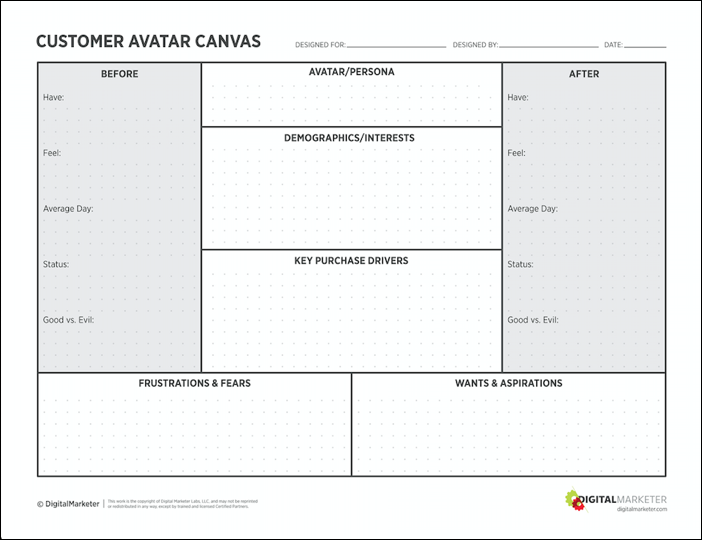
The best way to figure this out is by turning to your trusty Customer Avatar Worksheet, you know, that thing that defines exactly who your ideal customer is?

Customer Avatar Worksheet

If you’ve filled out your CAW, you’ll know exactly what your customers want and are interested in, what they are afraid of and frustrated with, and what kinds of media they consume.

And if you’ve filled out the Before and After grid, shown above alongside the CAW, you know how your customers are feeling before becoming a customer and how they should feel after buying your product or service.

With all of these resources, and a good working knowledge of your ideal customer, you should be able to easily craft a story that shows the transformation.

If we look to Starbucks as an example, they knew just how much their customers wanted it to be Fall. They understood the frustration with the hot weather or the fear of the current social chaos. 

So they created a story about falling into the new season (the pun was just a happy coincidence), and targeted their marketing efforts into creating a relaxing, enjoyable fall experience.

Some copy from the Starbucks announcement

And their biggest marketing push (aside from the drinks themselves) was for the fall hotline they created. 

Customers could call in and hear the sounds of fall, long before the actual season hit them. Not only did this hit on the exact pain point, but it crafted a narrative around the transformation.

Fall hotline from Starbucks

They knew exactly what their customers wanted, and delivered it in their marketing efforts.

Decide How Your Product or Service Fits In

Once you know what your customer wants, your next step is to decide how your product will fit in. 

With some holidays, you might be providing a great gift that will charm and impress their loved ones. 

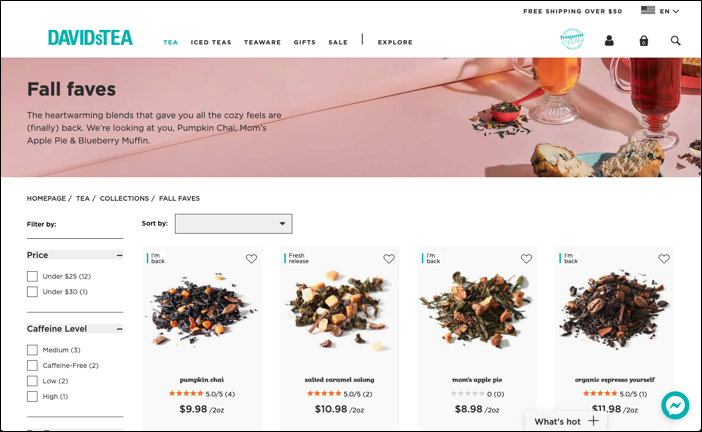
Or, if you are like David’s Tea (in a similar way to Starbucks), you might be providing a comforting environment and a joyful experience. 

David's Tea Landing Page

However your product fits in, make sure to keep that action as a central point in your marketing story, and keep it as consistent as possible across all platforms and content. 

You can see how David’s Tea used the same language, “this heartwarming blend will give you all the cozy feels” on both their product page and their Facebook ad. 

David's Tea Facebook ad for fall teas

Keeping your story the same on different platforms not only means you are sure to reach all your customers, but it helps solidify the emotional response your customer will have.

For David’s Tea, any potential customers who saw the ad and thought, “ohh I need some coziness in my life,” they don’t get jarred by a different message when they hit the landing page.

Craft a Story Where Your Customer is the Main Character

The central idea of creating a marketing “story” is that your customer is the star. You want the messaging to center around the customer and how they will feel and change rather than your product. 

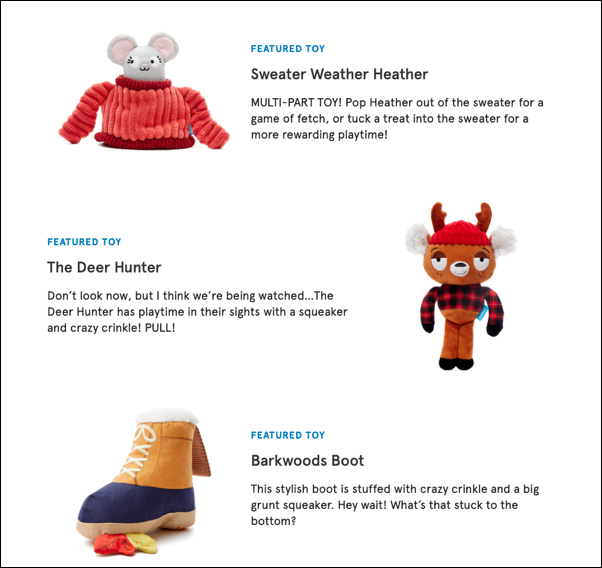
You can see here with this BarkBox copy, they have gone even further with their story than the other examples, going so far as to cast their customers’ dog (arguably the real customer, though maybe not the one with final buying power), into a story about a lovely fall drive.

Anyone with a dog (and a heart) will immediately be drawn into the story and see themselves and their furry best friend in this car ride.

And then when they read through the rest of the product description, they are still within that relaxed, happy emotional state, and are drawn closer to the products by extension.

Product descriptions from BarkBox dog toys

Plus, who wouldn’t be charmed by a sweater wearing mouse?

No matter what your story is, make sure you are making your customer the main character. Cast them as the star, and they will make a better connection to your brand and the product you are targeting them with. 

By crafting an emotionally driven story that hits on the desires of your audience, you’ll be sure to cut through the noise of the season and solidify your customers’ love for you and your brand.

And if you want to feel better prepared to put your holiday marketing story into action, download our 2020 Holiday Marketing Preparedness Plan. 

After all, what is a better gift this holiday season than having a handle on your marketing campaign before the season even starts? Well, maybe a PSL… but that could just be me. 

The post How to Craft the Story for Your Holiday Marketing Strategy appeared first on DigitalMarketer.


from How to Craft the Story for Your Holiday Marketing Strategy

Tuesday, September 15, 2020

Episode 271: A Tale of 2 Ad Accounts: How to Sell (and NOT Sell) on Facebook

This week we’re focusing on advertising your ecommerce offers on Facebook and a harsh truth. If your ads aren’t working it might not be your ad, it might be your business. In this episode, Angela Ponsford, VP of Media Buying at Tier 11, is going to show you 2 different ad accounts that Tier 11 is running and the differing results they’re getting (and why). You’ll also get a quick update on what’s working and not working on Facebook right now—hot off the Tier 11 press!

RESOURCES MENTIONED IN THIS ARTICLE

Mobile/Responsive Web Design Tester
Organic Aloha Prime Steak Rub & Seasoning
The Lean Startup
Create Custom Metrics in Ads Reporting
Actions Attributed to Your Ad
Episode 166: Why Facebook Traffic is NOT Your Problem
Episode 175: 3 Ways to Increase the Average Order Value for Your Ecommerce Business
Manuel Suárez Coaching (Coupon Code: PODCAST)
Ad World Conference 2020
Ahrefs

Thanks for joining us this week. Want to subscribe to Perpetual Traffic? Connect with us on iTunes and leave us a review.

iTunes not your thing? Find us on Spotify, Stitcher, or TuneIn.

The post Episode 271: A Tale of 2 Ad Accounts: How to Sell (and NOT Sell) on Facebook appeared first on DigitalMarketer.


from Episode 271: A Tale of 2 Ad Accounts: How to Sell (and NOT Sell) on Facebook