I know this is an odd question, but me and a few of my friends have been pondering this question for a while now.
Here’s why. I’ve come to the conclusion that it would be pretty hard for someone worth $5M+, who is responsible to squander their money.
For example, if I had to spend $300k today, I’d probably go buy a Lambo. But in buying a Lambo you didn’t really spend $300k. The Lambo is still worth $250k. So you’ve blown $50k.
However if I put a turbo on my 4Runner and give it a chrome...
Just throwing it out there to see if anyone has advice or a "know-how".
I'd like to find out the accurate shape/location of pressure applied to the palm during heavyweight exercises in the gym (mostly pushing - bench press, OHP).
Preferably, also to find out points on the palm that experience the most pressure from the weight throughout exercise.
Is there a device or some sort of material that I can put on my hand - that will help me achieve this task?
Of course, where there’s gold, there’s competition. To stand out from the crowd and land any of those great jobs on LinkedIn, you need a plan.
That’s why we’ve put together this handy guide. It will give you a step-by-step walkthrough of the most effective tips to leverage LinkedIn’s massive job platform — tips that’ll help you find, and land, a new job.
And we’ll start with arguably the most important one…
1. Create a Standout LinkedIn Profile
Optimizing your LinkedIn profile should be your number one priority if you want to land a freelance gig.
First impressions are integral in your job search. It’s essential to ensure that your LinkedIn profile offers a testament to your writing career, expertise, and experience level.
Try these top tips to enhance your LinkedIn profile to attract more freelance clients:
Create a succinct LinkedIn headline that captures your expertise in three key phrases
Fill your bio with relevant words and phrases so it’ll rank higher in LinkedIn job searches
Include a digital portfolio of your best freelance work
Use a professional, approachable headshot for your profile photo
Post an up-to-date, well-presented resume
Demonstrate your expertise and technical ability using Skills & Endorsements
Offer social proof with recommendations from your past freelance client base
Remember to make sure your profile is visible to everyone — especially your profile picture as professionals are less trusting of candidates without professional photos. You can do this by going to LinkedIn’s homepage (or any page, really), clicking “Me” in the top-navigation menu, and going to “Settings and Privacy”.
In addition to pictures, I highly recommend creating a video resume or animated explainer video that details your writing process, your style, your quality, social proof, and more.
Editor’s Note: If creating a video resume sounds daunting, check out this great guide from Madeline Mann. It’ll show you how to create a video CV even if you don’t have any editing skills (or enjoy speaking on camera):
Finally, make sure your profile is grammatically correct before applying for any jobs. According to Talent Inc., 79% of employers will ignore LinkedIn profiles, resumes, and job applications that have spelling or grammar mistakes in them.
If you’re prone to mishaps, use spelling and grammar tools like Grammarly and Hemingway to ensure your LinkedIn profile is free of errors and easy to read.
2. Fill Out the “Open to Work” Section
If you want to land freelance clients, you need your LinkedIn profile to be visible to potential recruiters, writing clients and LinkedIn connections.
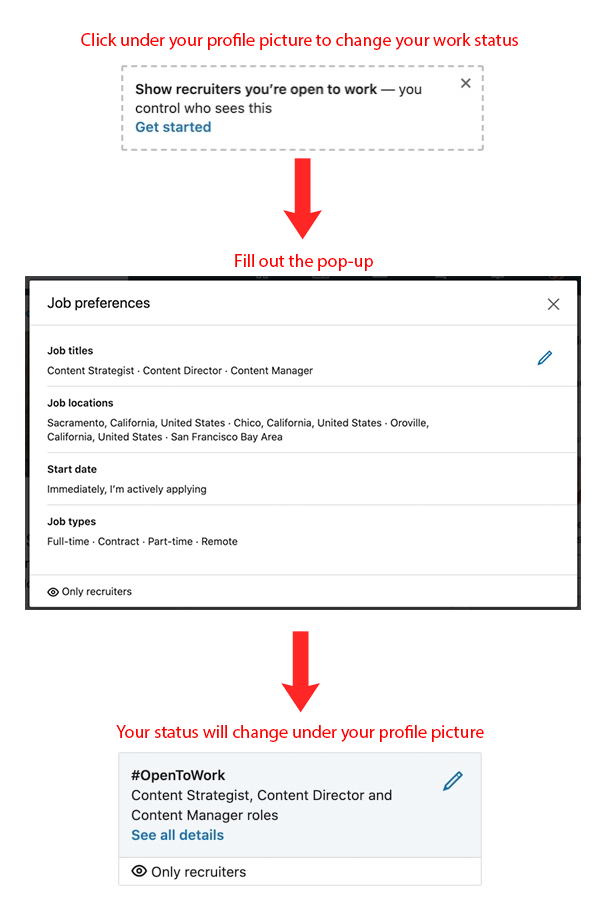
Just under your profile picture, you’ll find a small box that invites you to show that you’re job hunting. By switching on this feature, your next potential employer can see you’re ready to take on a new job.
If you haven’t changed the settings, simply:
Click on the box that says “Show recruiters you’re open to work”
Fill out the pop-up with your relevant writing skills and geographical availability
Save the changes
To make sure it’s changed, check back to the box under your profile picture.
If you’ve done this correctly, this box should state that you’re #OpenToWork.
3. Personalize Your Job Applications
Gone are the days when you could print a hundred resumes for your services and send them to “Dear Sir/Madam.” No, you need to personalize each job application.
By customizing your resume and cover letter for each specific job posting, prospective employer, and related industry; you’ll find potential employers to be more responsive.
A whopping 1/3 of employers say that a non-customized resume is a deal-breaker. If a job seeker turns in a generalized resume with no connection to the job posting, employers will simply ignore them.
With this in mind, you should be tailoring your resume and cover letter to speak to each individual job.
My advice?
Craft templates using a document collaboration tool such as Google Docs or Microsoft 365 that you can then customize for each prospective employer or client.
Try these tactics:
Find out the name of the hiring manager and address your job application to this person directly
Document relevant industry-related work experience
Research the prospective employers business and figure out a problem that you specialize in solving
Offer previous client testimonials as social proof of your best work
Include points about why you like the job posting and how it suits your skill set
If applicable, link to a portfolio of your work or to published works from previous jobs
Only present up-to-date work
Avoid rambling on about irrelevant achievements
4. Research the Companies You’d Like to Work With
The first step to finding companies you’d like to work with is figuring out which niches or industries most appeal to you.
For example, if you were a writer, ask yourself questions like these to find your ideal niche/industry:
What style of writing do you excel most at?
In which industry-areas do you enjoy writing?
What values would I like the companies I work for to uphold?
What types of projects are a no-go for you?
Next, take your top industries, and find companies within those sectors that implement your values and excite your passions.
Follow these accounts to add them to your LinkedIn connections so you can stay up-to-date with their progress.
Now, search within those organizations for job roles that suit your expertise.
So, if you’re a writer, you might search for roles like:
Content Writer
Content Marketer
Social Media Manager
Content Marketing Manager
Content Strategist
Digital Marketing Manager
Content Manager
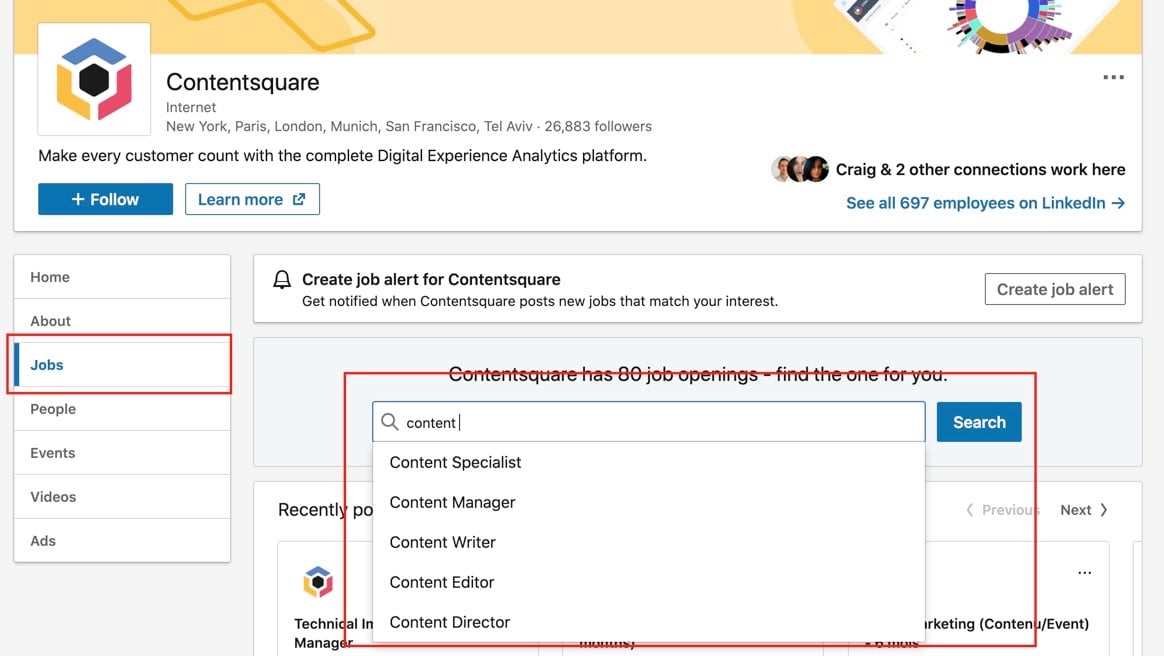
You can search for such openings in the “Jobs” section on the left-hand side of the target company’s LinkedIn page:
The “Jobs” page will showcase the company’s top available job postings right now. These are usually ordered by how recently they’ve been posted.
Hopefully, a job posting will jump off the page.
But if not, use the advanced search function to search for relevant job titles.
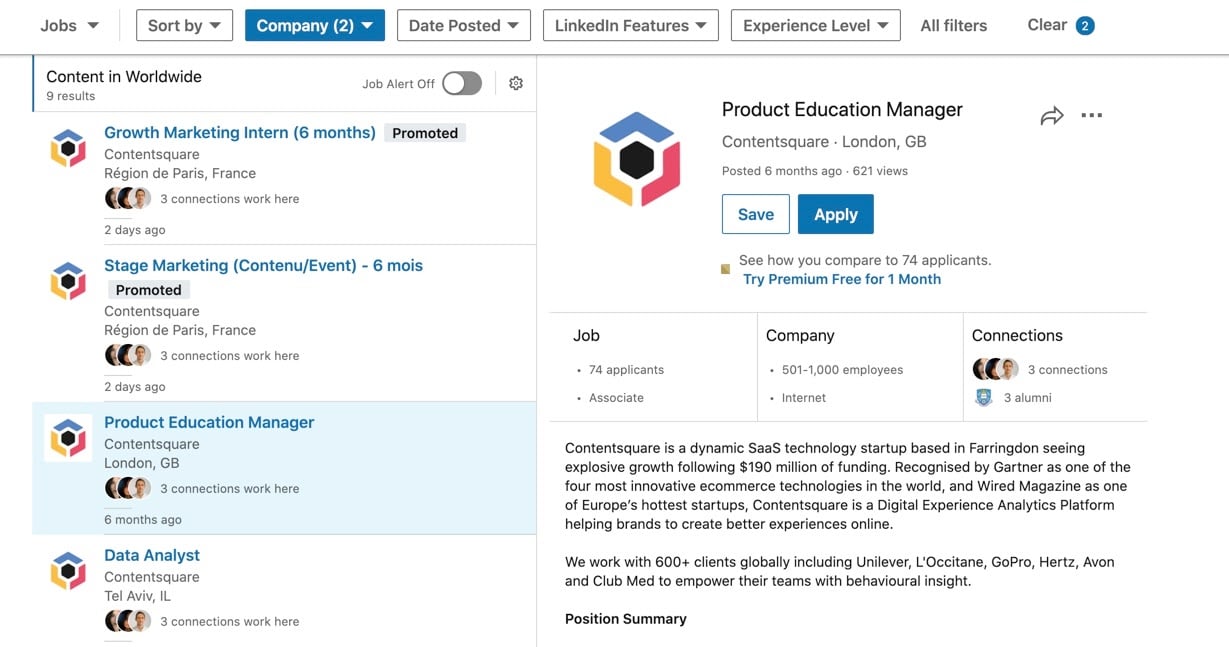
When you search for a job posting, LinkedIn will lead you to a list view of each job opportunity.
Click on each job opening to see a full job description of the job opportunity. You can save jobs that catch your eye or apply directly from this page.
LinkedIn also shows you how many applicants have applied for your dream job, as well as any mutual connections you have that work for the prospective employer.
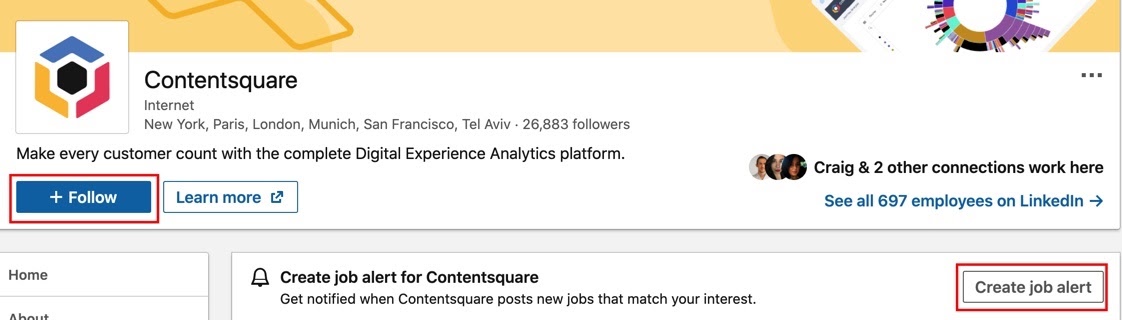
Not finding any good job openings with a company you really like? No worries. You can “Follow” the company and create a job alert:
LinkedIn will then notify you whenever a new position opens within the company.
5. Build Your Network and First-Degree Connections
Start building your first-degree LinkedIn connections by adding people you know from real life — even if their own job roles are irrelevant to your career.
Begin with your professional circles. Add:
Previous clients
Past employers
Other colleagues and ex-colleagues
Connections you know from your general career
Professionals outside your industry that you know through business
Next, add professional connections you know from your social circles. Find LinkedIn connections for:
Friends with professional careers
Associates with similar job interests
Alumni and school friends succeeding as professionals
Friends of friends who thrive in the professional world
People you’ve hired for their services
To exhaust everyone you know, run through your Facebook contacts, email connections, phonebook, address book, old wedding invitations, and more.
Remember, it only takes one excellent lead to land a career-changing job.
You may find that your real-world contacts have LinkedIn connections with a job opportunity available that neither of you had considered, making way for an introduction.
Remember to include everyone from your aging rolodex. You never know which alumni or school friends may be the connection to your ideal job.
But don’t stop there.
You can have up to 30,000 LinkedIn connections, so take full advantage. Try searching for connections who would hire someone with your very particular set of skills.
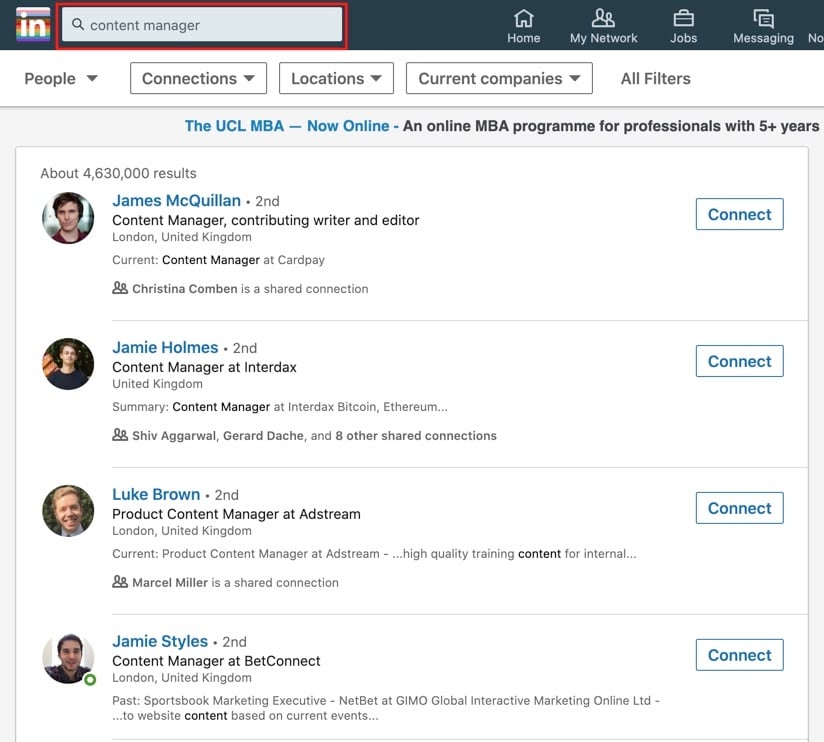
As a content writer looking to build a LinkedIn network, you’d want to connect with content managers of companies with job openings you’re interested in. You could also try connecting to:
Content marketing managers
Content managers
HR managers of content agencies and writing firms
Marketing managers in small business in your industry
When asking to connect, take advantage of the “connection request” message box with a succinct call-to-action. How you word this could make or break your connection.
You only have 140 characters, so try something like:
Thanks for connecting, Jamie. I think I can help you with X. Let’s book a call! [link]
When it comes to outlining ‘X’, refer to:
A LinkedIn job posting you have seen
A common interest
An post written by the connection
An issue your connection is having
Something you’ve noticed on their website, social networks, etc.
6. Ask Your Connections for an Introduction
When searching for job opportunities, you may notice that LinkedIn alerts you of mutual connections.
Each of these mutual connections is a potential gold mine.
If you see that one of your connections has a link to a job or professional you’re interested in, ask them for an introduction.
But don’t stop there. Sift through your first-degree connections’ connections. You may find second- and third-degree connections that could be useful to you.
Additionally, when searching for prospective employer connections, prioritize those that identify mutual connections.
These second- and third-degree connections are warm leads. They could be your ideal client, but without an introduction, it can be tough to get your foot in the door.
When connecting to these prospective employers, ask your first-degree connections to warm these prospects up for you with a referral.
Asking for a referral is easy — just craft a personalized message. If you’re a writer, it might look something like this:
Hi X,
I hope you’re well and everything with life and business is prospering. I saw that you have been doing X,Y, Z.
Currently, I’m in the process of pivoting my career/accepting new freelance clients. During my search, I found LinkedInjob postings that have mutual connections with you.
If it wouldn’t be too much trouble, I’d love you to introduce me to [name the connection]. I’m interested in connecting as they have a [job/role/network] that I’d be interested to explore.
Would it be possible to connect the dots for us?
I recognize that you’re busy, and hope you’re thriving.
Thanks
[Your Name]
If you’re confident in your relationship with this connection, contact them directly or send them an InMail.
If you’re not all that familiar with them, don’t be shy. They may have seen your work posted on your LinkedIn profile or know your work from mutual connections.
You can use the official LinkedIn referral system to ask for a referral for a job directly.
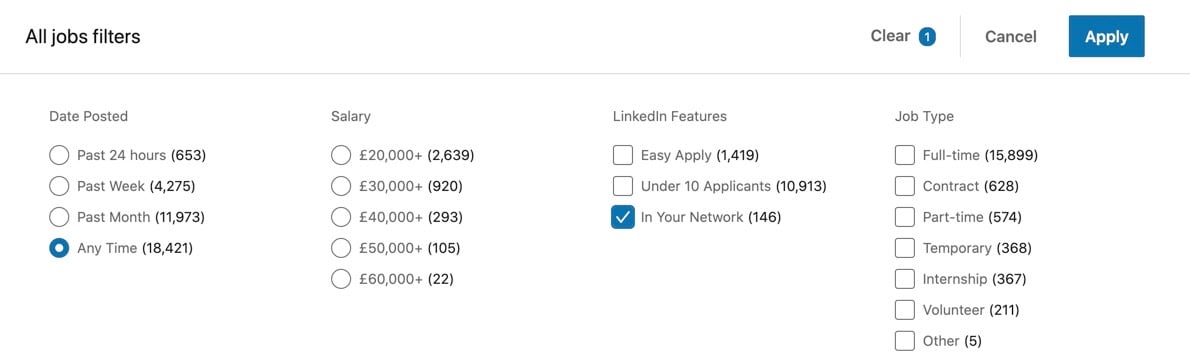
If you see a job posting in the “In my Network” search, click the “Ask for a Referral” button if you have mutual connections.
7. Share an Update of Your Availability (and Tag for Searchability)
Use LinkedIn as a place to regularly let potential clients and employers know about your availability.
Release weekly posts that let people know your schedule.
By demonstrating that you’re available for work, your connections may be able to direct you to positions they know about.
Plus, if you’re a freelancer, showing your schedule sends a virtual signal about the demand for your work. Try posting a weekly updated schedule that blanks out unavailable times.
This is especially effective if your freelance diary fills up fast, as it creates urgency and implies that your work is high quality.
To optimize your job updates for the best visibility on LinkedIn, try these tactics:
Tag companies and professionals within your niche
Tag companies with open job postings
Use relevant industry and topic-specific hashtags
Tag your current clients
Tag past clients in case they need new work
8. Engage with Industry-Specific LinkedIn Groups
Depending on your profession, you may straddle a few different industries. Luckily, you can find a LinkedIn Group for everything.
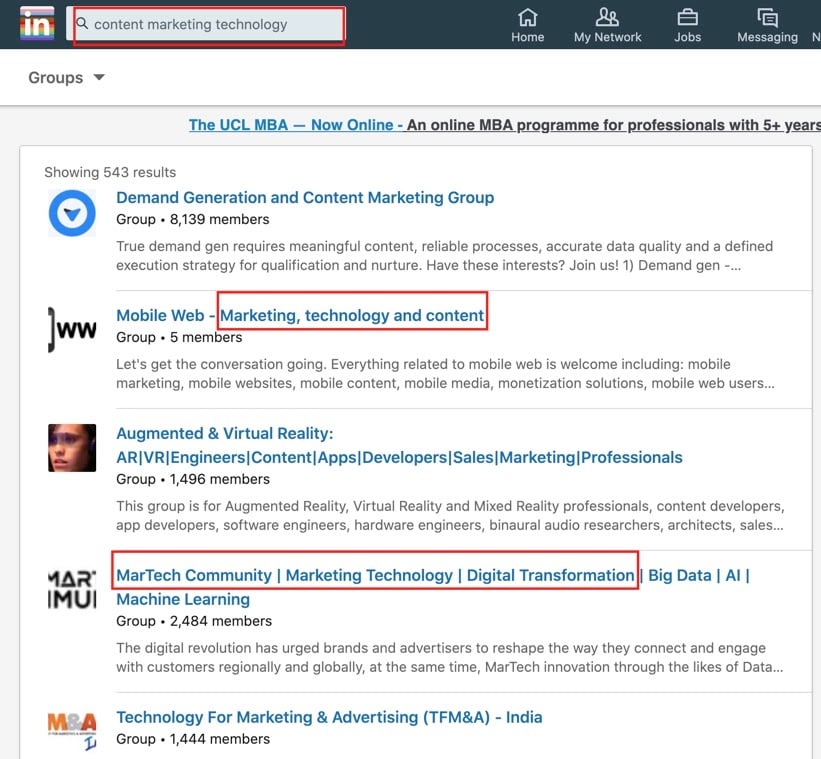
Find the LinkedIn groups where the industry professionals relevant to you are congregating. This is where key decision makers will be asking for tips and referrals for hiring and managing remote workers.
You need to establish a reputation in each relevant LinkedIn group. Do this by:
Sharing content from other members of the LinkedIn group
Liking and commenting on posts by other members
Ask questions to learn from other LinkedIn members
Share content from industry thought leaders that you think the Linkedin group members might enjoy
Make a website and share your own content to show expertise
By contributing to the group, you show any onlooking potential clients that you’re established in the industry.
You also broaden your LinkedIn network, boosting the number of connections on your LinkedIn accounts.
This creates a snowball effect where you see more and more relevant job openings in your feed. As you build an industry-specific LinkedIn network, you’ll find you can automate the process for sourcing each new client.
9. Share Valuable Content as an Industry Thought Leader
You need to establish your credibility, authority, and expertise to build trust with potential freelance clients. This demonstrates you as a thought leader; a freelance professional worth high rates for high-quality work and forward-thinking ideas.
Since your own work requires you to create outstanding content, demonstrate these skills by implementing your own personal evergreen content strategy for LinkedIn.
If you’re put off by the time commitment to develop such a strategy, don’t be. You can easily set up a content marketing workflow to streamline your efforts and become visible across multiple mediums.
Build a LinkedIn content strategy where you release regular self-authored content that shows your passion and interest in the industry, alongside your exceptional content-creation prowess.
In addition, be sure to leverage things like infographics that are easily shared on LinkedIn. These can go viral far faster than just text-based articles alone.
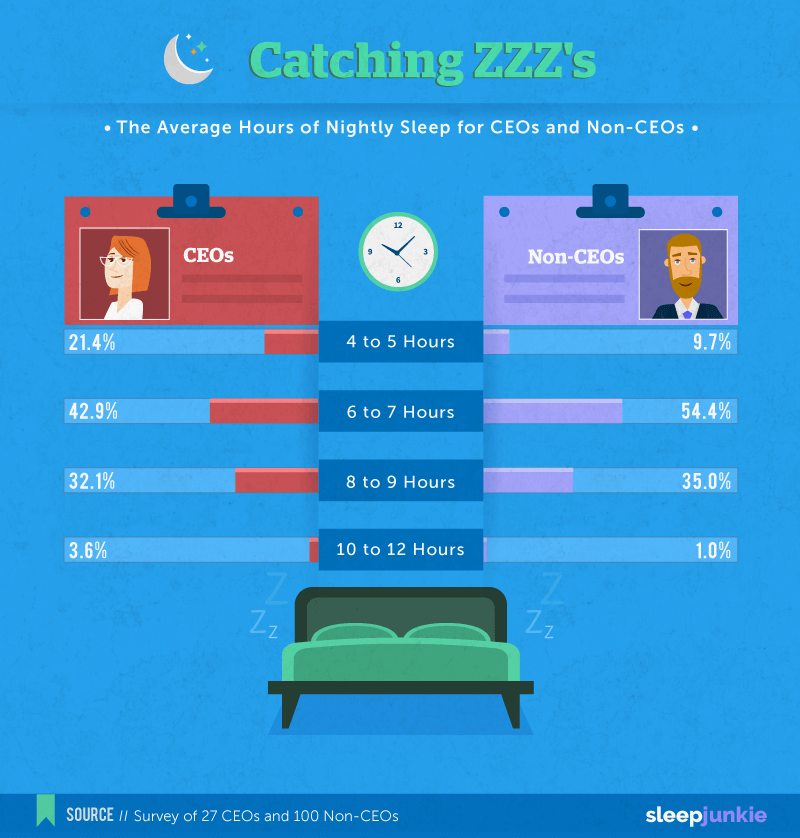
For example, pick a subject matter that is of interest to your target market (like how CEOs sleep) and create a great infographic for your article:
Demonstrate how you would solve problems in your sector
Given personal opinions on current affairs related to your industry
Share content and insights from other industry thought leaders
Teach potential customers the value you have as a freelance content specialist
Show prospective clients how your finished work looks
If you don’t have time to create content, you can always consider creating your LinkedIn content strategy and outsourcing it to another content writer.
Since content needs to be thorough (around 1,890 words minimum, according to experts), don’t settle for the first or cheapest writer you find.
By paying someone to create a regular, high-quality LinkedIn campaign, you’ll show consistency to your prospective clients and you’ll appear in job searches more often.
If you’re really struggling to get your own ideas down, at least try to share engaging industry-specific content.
10. Interact With Other Thought Leaders’ Content to Increase Visibility
Increase profile views and set the way for partnerships and referrals by interacting with other experts in your industry.
Marketing guru, Gary Vaynerchuk, explains this idea well with his $1.80 strategy.
Here’s the idea:
Find 10 top hashtags for your niche. Comment on, share, or like the top nine posts of each of those hashtags. Tailor your interactions to establish the importance of your particular freelance services within this niche.
Repeat this process and you’ll start to form LinkedIn connections with others in your industry, priming you for referrals.
Why is it called the $1.80 strategy? Because you give your “two cents” over nine posts across 10 hashtags. $0.02 x 9 x 10 = $1.80.
Try using sales tools, like LinkedIn Sales Navigator, to pinpoint important industry professionals.
11. Reach Out to the Hiring Manager (Bonus Strategy)
While you can apply for a job offer through the normal LinkedIn channels, why not show some initiative?
Find a new opportunity you like where the hiring manager is considering hiring someone full-time. Instead of applying for the job, try to connect with the decision maker by sending a direct InMail or cold email offering your freelance services.
Try to include a stellar portfolio, including links to your work, an introductory video, and a landing page to book an appointment.
Ready to Get a Job Using LinkedIn?
For many freelancers, LinkedIn is the go-to resource for making new connections and landing their next job.
How about you?
Ready to expand your professional network? Ready to end your job hunt and land your dream client?
Follow the strategies outlined in this post, roll up your sleeves, and make it happen.
Hello,
Hope all is well today. For a one man show, I think I do my best to hope myself accountable and to keep myself on track. I think what could take me to the next level is to have a mentor that would hold me accountable and be a sounding board to all of my crazy ideas.
My question is where would I find a mentor if I have exhausted the circle of people I know? I've tried searching for other sites but couldn't come across anything that had potential.
Hi folks, I'm hoping to get some insight on a tax-related question.
I recently opened up an e-Commerce website for dropshipping to the US. I'm Canadian and the business is registered in Canada. To avoid dealing with US taxes and avoid establishing "nexus", I always choose the "Ship from China" option for all products. However, when looking at the tracking info, I see that most of the products are being shipped from within the US. I use AliExpress and CJDropshipping to dropship, and both are...
This month's new book discussion. We didn't vote on it, but this book is consistently rated highly in the vote counts and has been mentioned many times.
This post is based onepisode 60 of the ProBlogger podcast.
One of the most common questions I hear from my readers is “How do I get my readers to interact with me?”
Of course, there are plenty of answers I could give to that question. But for the next couple of weeks I want to talk about one particular method: building a community.
And I’d like to start by giving you nine reasons why you should build one around your blog. (Next week I’ll show you how, I promise.)
1. It increases your blog’s usefulness
I’ve always believed that the way to build a successful blog is to build a useful blog. And in my experience, building a community around your blog makes it more useful.
In his book The Wisdom of the Crowds, James Surowiecki said that together we are a lot smarter than any single one of us. And I’ve seen the truth of that statement on blogs many times, especially my own.
I once received an email from a Digital Photography School reader asking for advice on how she could photograph her dying grandmother with dignity. Her family didn’t have many photos of their grandmother, who in hospital at the time and expected to pass away in the coming week.
The trouble was, I had no idea how to even begin answering her question. But I wanted to give her an answer, and so I posted her question (with her permission) on the blog.
Within a week we had 90 people offering all kinds of interesting and useful ideas on how she could photograph her grandmother during this incredibly tough time.
And that’s just one example of how a blog’s community can make it more useful.
2. It builds social proof on your site
If you’ve ever walked down a street looking for a restaurant to eat in, you’ve probably seen the power of social proof. We’re generally drawn to the restaurants with people sitting in them rather than ones that are empty.
And the same is true with blogs.
It’s much easier to attract new readers to your blog when you already have readers who are engaging – commenting, engaging in polls, engaging in your social media channels, etc.
3. It increases your page views
If you’re monetizing with your blog with advertising (e.g. AdSense), the number of page views you get often dictates how much money you can earn. And having a community regularly making comments on your posts can certainly increase that number.
Let’s say someone views one of your posts and decides to leave a comment. That’s two page views straight away – one for the initial visit and one for when they publish their comment. And that’s just for starters. Chances are they’ll come back to read other people’s comments (especially if you use something like Discus that notifies them when someone has replied to theirs). And the more people you have in your community, the more comments you’ll get and the more page views you’ll rack up.
4. It makes your blog more attractive to advertisers
Over the years I’ve found that advertisers are much more likely to advertise on your blog if there’s a community of readers they can engage and interact with directly.
Once a year we run a competition on Digital Photography School with the New York Institute of Photography (one of our advertisers). Initially they approached us and said, “We might want to run a comments competition.” As part of the competition, people had to go over to their site and choose which course they wanted to win, and then give a reason for wanting to win that course in the comments.
The first time we ran the competition they had hundreds of people leaving comments to try and win. And they’ve been coming back to us every year to run the same competition ever since.
5. It makes it easier to sell products on your blog
Whether you’re selling a product or a service, people will be far more interested in buying from you if they feel like they know you and have engaged with you and your community.
Over at Digital Photography School we have more than 35 e-books for sale. And the people who tend to buy them the most are those who comment in our forum, leave comments on our blog and engage with us on social media.
It also makes it a lot easier to decide what you should be selling. After running the 31 Days to Build a Better Blog series of posts a few times, my readers started asking if I could build a product around it. I eventually turned the series into an e-book, and it became my biggest selling e-book ever.
6. It makes your blog more attractive to sell
Over the years I’ve had a number of companies offer to buy my blogs. Naturally they want to know about our traffic and the income I earn from them.
But in a couple of cases we talked about the community I’d built on my blogs, and the engagement I have with my readers. And every time their eyes lit up, and the offers became far more generous.
7. It gives you an army of advocates and evangelists
There’s another big advantage to building a community around your blog. That community can help you grow in both readership and popularity.
Soon after starting Digital Photography School, a highly engaged reader who commented a lot on the blog emailed me and said, “Hey, I know a journalist at the New York Times. Would you be interested in being interviewed by them? They’re looking for bloggers at the moment to interview.”
And why did they make such a generous offer? Because I knew them, and had engaged with them many times.
8. It can help you to build user-generated content
You’re far more likely to attract guest posters and contributors if you engage with your readers. And there are other ways they can help you generate content for your blog.
I’ve asked my social media followers to share their advice on different aspects of blogging on social media, and then turned their responses into blog posts. I didn’t need to write much at all, because my readers gave me most of the content.
They can also help you start conversations that will in turn generate even more content. We once asked our readers on Digital Photography School what brand of camera they used, and then created a follow-up post where we ranked them in order of popularity amongst our readers. Of course, that opened up a can of worms and created a number of debates and interesting discussions.
9. It brings more personal satisfaction to your blogging
One question I get asked a lot is, “How have you managed to keep blogging for so long?”
And my answer is always the same: “I love my readers.”
If I didn’t have the community, comments and engagement that I’ve managed to build over the years, I may not have stuck at it for this long.
One more reason to build a community around your blog.
But don’t expect it to happen overnight. Building a community can take years. And when you’re pouring your heart and soul into your blog and no-one is commenting, it can be very disheartening.
There may even be times where your community goes sour. I’ve seen it happen to a number of bloggers over the years. Sometimes it’s because they haven’t invested much (if anything) into the community. Other times it’s because they did something wrong and weren’t transparent about it.
But overall the benefits of having a community far outweigh the costs.
And now it’s time to start building
Now that you know the benefits of building a community around your blog, it’s time to start building one. And in next week’s post I’m going to give you tips on how you can do just that.
Hi all. I'm a newcomer to the forum, (longtime lurker), but I read through MJ's books for the first time about 3 years ago (they completely shifted my employee, slow-lane wealth accumulation strategy mindset into the fastlane, entrepreneurship mindset).
In short, since then I've been slowly building out my SaaS application part time, while I was working full time as a programmer. I've since started doing this side hustle full time, and now have two companies testing/using this application...
Background: I am a 35 yo entrepreneur in my 7th year of tech-hood, business are going well and expanding, and there is a chance we can be something bigger. Right now, the firm's limit is my own ability to handle the business and myself, and I've come to realize that personal discipline will be most people's demon, at least it is mine. I want to create the ultimate habit of good life.
No Porn (7th day)
This sounds perverted, but it's something...
Hello, I'm HydroxZ, I used to be a gamer, had more than 10k hours in a single game and I used to play a lot of games. My "passion" for videogames led me to get rejected to exams last year of High School so I had to retry because of parents but I eventually dropped out and went to work.
Was working in a shirt factory for 8 hours a day and coming back home pretty exhausted, but I was happy because I could work and play without anyone bothering me.
Does anyone have a lot of energy for day to day stuff, but as soon as it comes to completing the tasks you've set for your business e.g. Shopify or Amazon, suddenly you have a huge surge of "I cba" or want to crawl under the bed, but as soon as it comes to going gym or doing something physical I have all my gears dialed up and ready to go
That title could have been me, yesterday. It turns out there is a yellow jacket nest in my yard that is at least 4 feet by 4 feet by 4 feet.
I mowed part of that nest yesterday, on a riding mower.
A cloud of thousands of yellow jackets was quickly on me. The sound of the mower was drowned out by buzzing. The air around me was darker, shadowed by the little devils.
It's hard to count the number of stings, but hundreds I guess. They were all over me, but more on my back and right arm. I ran...
Hey. I'm a 27 year old PhD student. (Chemistry/Materials Science) Just started to read and get into the ideas that are floating around this sphere. I'm due to finish in a few months and I'm gonna grind and save some money and get started. I'm not sure what I am specifically looking to start yet, I've got a couple of ideas floating around but I want to make sure they don't violate the CENTs framework. Any advice for someone in my position?
I joined a Facebook group recently and an agency owner asked how to get his freelance graphic designer and freelance developer working together better.
5 people replied with "PM me."
I wrote a 12 bullet point reply with my learnings and tips.
I didn't ask him to PM me, I didn't even consider it. I was "post and done".
He friended me, then PM'd me, and we're in email conversation now and who knows where it may lead.
Thought I'd start a thread based upon the CENTS Business Commandments found in The Millionaire Fastlane and UNSCRIPTED, just in case someone searches for it by search engine.
Since this concept is covered in both books, I don't think I ever posted an "official" thread on the topic. It would be nice to have a thread for it, especially for people who have never read my books and come across the concept in some other venue or dialogue.
Also, I'd like to document its existence beyond the 2...